


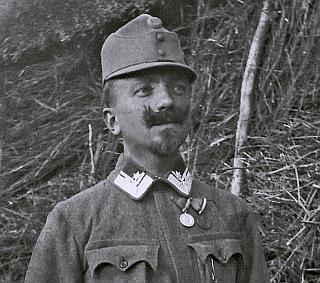
 | Švejk, Josef | |
| *8.6.1865 Svatá Kateřina - †18.11.1939 Svatá Kateřina | ||
| SearchŠvejkův slovník | ||
Josef Švejk was the name of at least two people whom Jaroslav Hašek could have heard of (or even met) when he created his famous soldier. The author hardly ever chose names for his characters at random, so it is safe to assume that some Švejk provided the author with the soon-to-be-famous name and perhaps the odd piece of biographical information. It was probably simply a case of using a name, and it is of course also possible that only the surname was borrowed (as was the case with Oberleutnant Lukáš and Kadett Biegler). In general, the author re-used only the family name, and even these were often altered slightly.
It is important to note that The Good Soldier Švejk was invented in 1911, so any inspiration for the author’s choice of name must be sought among people whom Jaroslav Hašek knew or was aware of in May 1911.
The origins
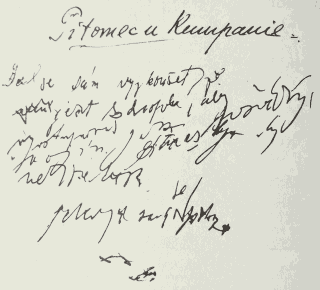
Hašek's brilliant idea, hardly legible.
The idea of creating a literary “company idiot” seems to have been spontaneous. Jaroslav Hašek's wife Jarmila recalled that he arrived home one evening in a sorry state and scribbled down a few barely legible sentences on a piece of paper. She attached no importance to it and threw it in the bin, but when her husband woke the next morning, he remembered his brilliant idea and frantically searched for the sheet. He found it, glanced at it, and threw it away again. This time Jarmila kept it, and copies have since appeared in most major publications on Hašek. The headline was Pitomec u kumpanie (The company fool).
On 22 May 1911 the first story appeared in Karikatury, titled: Švejk stojí proti Itálii (Švejk stands against Italy), and four more followed during the summer. It should be noted that his first name Josef never appeared at this stage. It was first revealed in Dobrý voják Švejk v zajetí (1917), the second version of The Good Soldier Švejk. Even in the novel it appears only a couple of times.
The name Švejk also appeared in two cabarets that were performed in the summer of 1911 by the group around Strana mírného pokroku v mezích zákona: Pevnost[a] and Agadir[b].
The politician Švejk
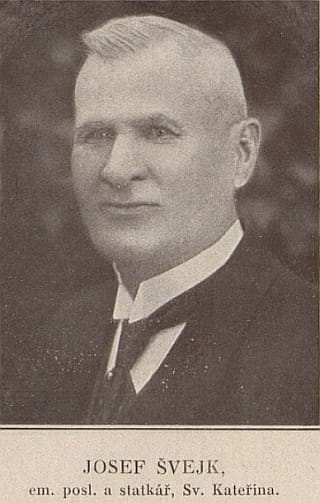
,1927
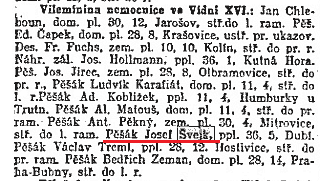
For years, researchers found little that could explain the origins of the name Švejk. Most were content to link him to a politician, Josef Švejk, from the Agrarian Party, and the possible connection between him and the good soldier was first suggested by Václav Menger in the inter-war years (according to Radko Pytlík). This Švejk was from Svatá Kateřina near Kutná Hora and, in 1907, he was elected deputy for Czech electoral district no. 58. At the time, he was the only well-known person carrying the surname.
Born in 1865, a notice about his marriage (from 1889) reveals that he was a k.u.k. reserve lieutenant at the time. In the army he served with the Trainregiment Nr. 3, in 1895 he was transferred to k.k. Landwehrinfanterieregiment Nr. 10, and on 31 December 1897 he was fully relieved from his duties in the armed forces.
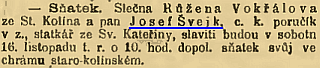
Marriage on 16 November 1889, as reserve lieutenant
From 1903, Švejk's name began to appear in national newspapers in connection with a by-election in Chrudim. He even reached the front page of Národní listy after tumultuous election meetings at which he regularly insulted his opponents, including František Udržal, who was elected ahead of his foul-mouthed opponent in 1903. Before the election in 1907, the outrageous behaviour was repeated, and he is recorded as calling his opponents traitors, dogs, scoundrels and socialists paid by Jews. Jaroslav Hašek must surely have read about, or at least heard of, Švejk's antics at some stage, particularly as Národní listy was a newspaper for which he often wrote. It should be added that, this time, Švejk was his party's candidate and was elected to parliament with a solid margin. In 1909, a poem mentioning his name appeared in the satirical magazine Kopřivy, another publication to which Hašek contributed at times.
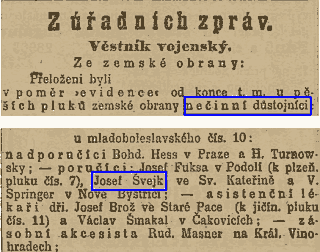
Transfer from Landwehr reg. no. 10 to non-duty on the 31 December 1897
In 1911, Švejk stood for re-election, and this coincides with the publication of the first story about The Good Soldier Švejk. This happened in the middle of the 1911 election campaign, in which Jaroslav Hašek took part with his unregistered Strana mírného pokroku v mezích zákona (Party of moderate progress within the limits of the law). The party was designed to mock politics and politicians, and the satirist and party chairman took aim at several of them, using their full names. Švejk's name does not appear among those Jaroslav Hašek mentions in the history of the party, but that does not mean that he was unaware of him.
As a deputy, Josef Švejk seems to have moderated his eccentric behaviour somewhat. He repeatedly stood up for Czech interests in linguistic, budgetary and cultural matters, and campaigned for agriculture and the countryside in general, but his hostility to the military was most striking. In a speech in Parlament in 1908, he claimed that the military "used every opportunity to harass our nation". Parliamentary records show that he was secretary of several subcommittees of the Abgeordnetenhaus, among them the defence committee. He campaigned against monopolies and cartels, mainly the sugar beet cartel. He himself grew sugar beet and eventually wrote a book on the history of the Czech sugar beet industry.
On 14 May 1911, eight days before Jaroslav Hašek published the first Švejk story, the agrarian MP was again in the news after attacking and insulting Dr. Hrachovský from Kolín, a member of the Christian-social party, in an article in the agrarian party's newspaper Venkov[d]. It is of course possible that Jaroslav Hašek heard about this dispute and that it inspired him to use the name Švejk for his story a few days later.
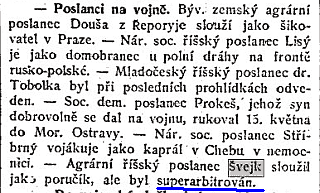
,19.5.1915
On 19 May 1915, a note appeared in the Catholic daily Čech, reporting that deputy Josef Švejk from the Agrarian Party had served in the army as a lieutenant but had been superarbitrated. This clearly refers to his departure from the k.k. Landwehr on 31 December 1897. The exact reason for his premature departure from the army is not known. Several news items from 1914 and 1915 confirm his superarbitration, but in 1915 he and 28 other Czech parliamentarians were called up for Landsturm medical examinations and he was again let off the hook.
In 1918, he again raised his voice in Parlament, supporting the Czech drive for parity within the monarchy, and even proposed seizing Slovak (i.e. Hungarian) land. His political career seems to have nosedived in the newly created Czechoslovakia, and he led a relatively anonymous life during the first republic. He died in his home village at the age of 74 and is buried in the local churchyard, where his gravestone gives him the title of captain.
Borrowing names
It could be argued that the agrarian politician had absolutely nothing in common with the good soldier (apart from the superarbitration, which Hašek may have heard of), but that in itself would not have stopped Jaroslav Hašek from exploiting his name. The author often chose a person's name only to attach it to a story that did not necessarily have much to do with its unfortunate subject. Břetislav Ludvík and Offiziersdiener Baloun are good examples of this approach. Ludvík was an artist and writer whom Jaroslav Hašek knew personally, while Baloun was the name of an Infanterieregiment Nr. 91 doctor, a one-year volunteer in the regiment, and a Vinohrady pub landlord respectively. Presumably none of them had much in common with the gluttonous miller from the Krumlov area, just as Ludvík had little in common with the cattle trader in Budějovice.
Introducing a second candidate
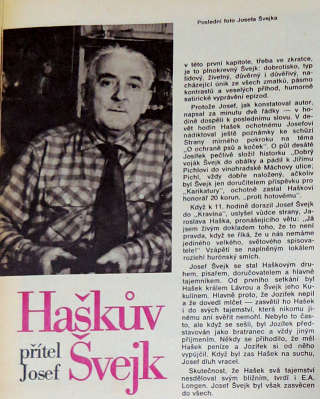
,7.9.1968
The next major revelation came as late as 7 September 1968. The glossy weekly Květy published an article that sought to identify a certain Vinohrady resident, Josef Švejk, not only as the originator of the name, but also as a person whom Jaroslav Hašek knew in 1911 and who even served as a prototype for the good soldier. The article was signed Jaroslav R. Veselý and contained photographs, a wealth of information and several sensational claims. Haškologists were sceptical, but at least Radko Pytlík and Augustin Knesl attached some importance to it. Knesl even took the trouble to investigate some of the clues Veselý left behind and was able to confirm that a Josef Švejk had indeed lived at Na Bojiští 463/10, by U kalicha, before the war. However, it was the Russian Bohemist Sergey Nikholsky who initiated a more thorough follow-up to the article in Květy. More on that later.
The article in Květy was titled Hašek’s friend Josef Švejk and opens with an interview with Josef, in which he recounts being called up for service in 1914, being led by his mother on crutches to Střelecký ostrov, and engaging in passive resistance, sabotage and feigned idiocy. He also summarises his time in Russia with the Čs. army (see České legie) and adds that he was decorated twice. The interview further claims that Josef met Jaroslav Hašek repeatedly after the latter's return from Russia and that Švejk attended the author’s funeral at Lipnice on 6 January 1923. The article also claims that the two had become good friends as early as 1911.
Josef Švejk's army career
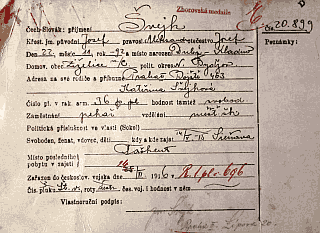
Kmenový list, čs. vojsko.
© VÚA
Veselý's article continues with Švejk’s army career. Allegedly, he had been called up before he met Hašek, but was “superarbitrated” after two months. He was called up again in January 1915, left Liberec for the front, and defected to the Russians later that year. The prisoners were taken to the transit camp at Darnytsa near Kiev, where Josef impressed the camp commander, Gribojedov, with his cooking skills and seems to have remained, rather than being sent onwards as one would expect.
Later, Josef joined the Czechoslovak Brigade (Czech and Slovak volunteers under Russian command) and reportedly took part in the battle near Zborów on 2 July 1917. Here we see many parallels with Hašek’s own time in the volunteer corps. The most striking claim is that the two met in Samara on 8 June 1918. At the time, Jaroslav Hašek had just left the Czechoslovak Army Corps to join the left wing of the Czech Social Democrats (communists). When the Czechoslovak troops (now officially part of the French army) rebelled against the new Bolshevik regime, Hašek came to be regarded as a traitor and was in a very difficult situation when his former comrades occupied Samara that morning. Apparently, an arrest order was issued by the command of the 4th infantry regiment, one of the units that attacked Samara. A patrol in which Josef Švejk took part found Jaroslav Hašek, but, according to Veselý, Josef mercifully let his enemy slip away.
Details confirmed
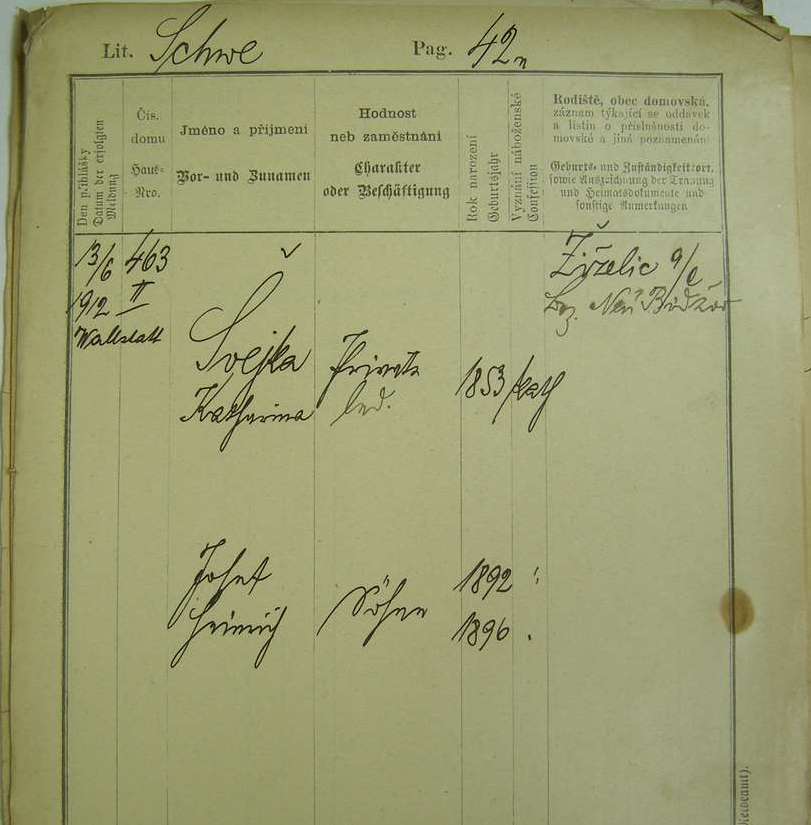
Police registers, 1912
The Květy article is written in a style that has more in common with fictional magazine stories than with a research publication. It even includes extensive dialogue, a fact that in itself detracts from its credibility. This is unsurprising, as Květy was in fact a glossy magazine, albeit one oriented towards news. The article makes no reference to sources (apart from the interview with Josef Švejk), and there was no longer any prospect of consulting its assumed primary source, as Švejk had been dead for three years. The identity of Jaroslav R. Veselý is also a mystery; presumably, it is a pseudonym.
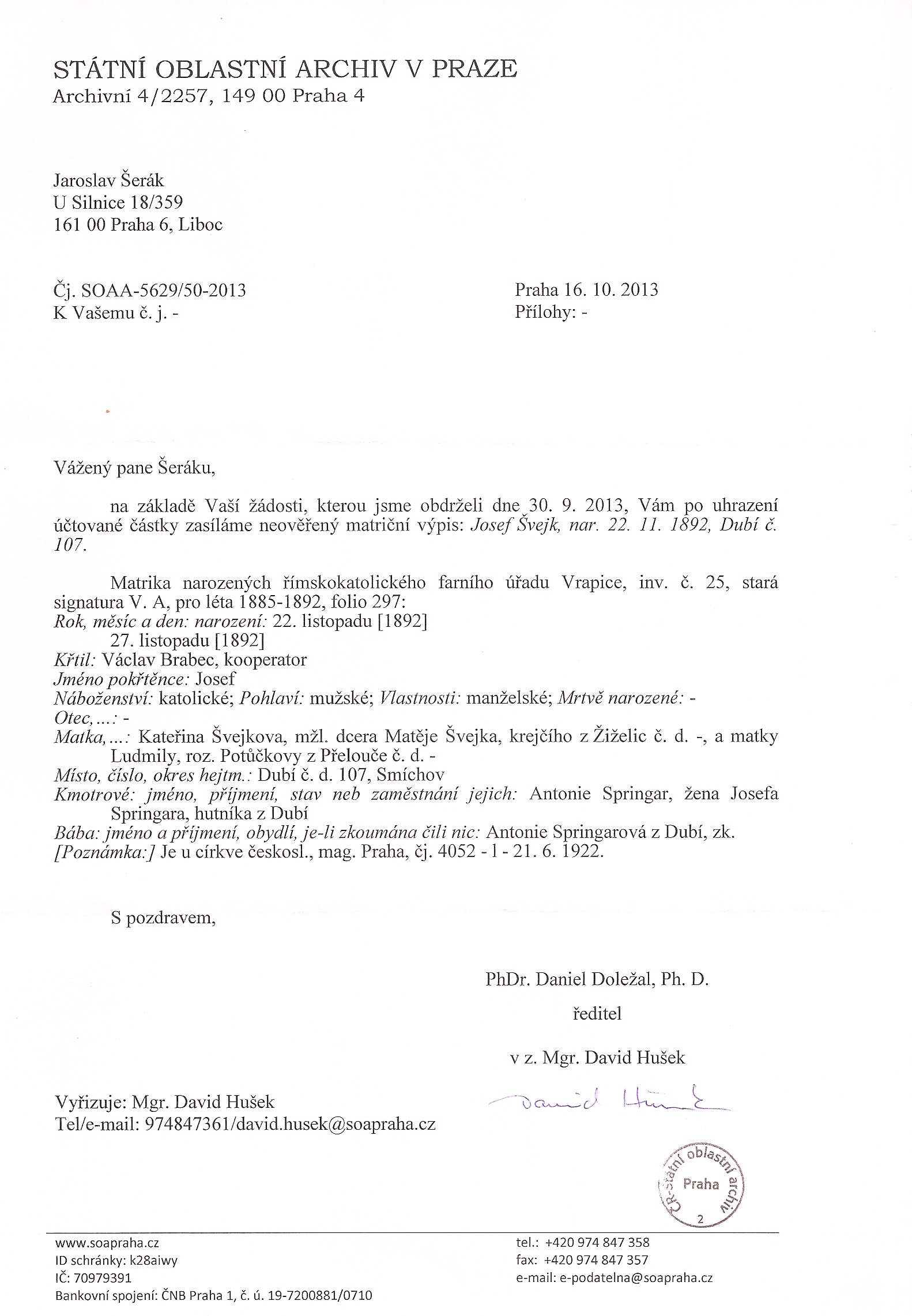
Church record, Dubí
Nevertheless, a surprising number of the article's claims have been verified. According to police records, a young Švejk was registered at Na Bojišti 463/10 (next to U kalicha) with his mother, Kateřina, and his brother, Jindřich, on 13 June 1912, so they may also have lived there 13 months earlier, assuming that they registered late with the police (Jaroslav Šerák). It can also be confirmed that a person of the same name joined the Czechoslovak Brigade in Kiev on 25 June 1916. He may well have met Hašek there, as the author of The Good Soldier Švejk arrived from the Totskoye camp only four days later and both were enrolled in the brigade's replacement battalion. The article’s reference to events that took place around May 1911 is also correct (parliamentary elections, the unveiling of a monument to Karel Havlíček in Žižkov, and so on). It has also been confirmed that Švejk was decorated in 1924 and 1947, and that he was captured near Sienawa on 14 May 1915 (Nikholsky/VÚA). Thanks to Šerák's research, his birth date has been confirmed as 22 November 1892.
Creating a bogus story
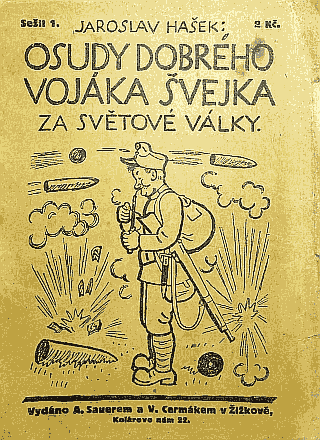
Josef Lada's first drawing of Švejk. Veselý claims Josef Švejk was sitting model at Kavárna Union in January 1921. Lada himself contradicts this information.
Although many of the claims from Květy can be verified, numerous others remain unconfirmed, and several appear to be products of hearsay and attempts to “fit the legend”. Josef Švejk is supposed to have been a good friend of Jaroslav Hašek and even to have attended his funeral. If so, it is a mystery why none of the author's friends and biographers noticed Josef's existence. According to Jan Mikolášek (allegedly the author's last living friend, but for similarly mysterious reasons unknown to biographers), Jaroslav Hašek told him that he had heard of a Švejk but never met him (Jan Berwid-Buquoy ).
It is also striking that the story of his sitting as a model for Josef Lada's first drawing of Švejk is flatly contradicted by the artist himself. According to Lada, Hašek visited him in his flat and asked him to make a drawing for the cover of the The Good Soldier Švejk instalments. He did so, but added that he created the slim, tall figure according to how he imagined Švejk and how the author described him. He delivered the result at the café U Mohelských, and did not meet Švejk and Hašek at Kavárna Union, as Veselý claims.
Also questionable is a picture of Josef in uniform that supposedly dates from 1911. At the time, he would have been only 19 and too young to have been called up for the army. In the picture, he also wears distinctions, which are hardly likely to have been awarded to a raw recruit who, moreover, was dismissed owing to idiocy (Sergey Soloukh). It has been confirmed that he held the rank of Korporal in the k.u.k. Heer, but surely not in 1911, nor even in 1914 (another picture). The story of his feigning idiocy and walking on crutches to the draft board bears the familiar mark of “reverse-engineering” literature back into the real world. This phenomenon occurs frequently in “Haškology”, particularly in newspaper and magazine articles published after World War II.
Another discrepancy was discovered by Jaroslav Šerák when he investigated the police registers. Mother Katěřina was unmarried and born Švejková, so the story about the father, who was also named Josef Švejk, clearly does not hold up. He might have been a common-law husband or an uncle, but his identity has not been established.
From Russia comes the story of the two meeting in Darnytsa. Josef Švejk was captured four months before Jaroslav Hašek and would surely not have been kept in a transit camp all summer. The story suggests that the pair met again in this camp and remained there until they both joined the Czech volunteer brigade. Army records reveal that Josef was sent onwards to Tashkent and Chelyabinsk, and it is well documented that Hašek spent his time in Russian captivity in Totskoye in the southern Ural. He was held in Darnica for only three days (Jaroslav Kejla), scarcely enough time to meet any Švejk, who had probably been in Tashkent or Chelyabinsk for a long time by then. The Samara story is also difficult to credit. Army records show that Švejk belonged to the 3rd regiment, a unit that did not take part in the attack on Samara; it had in fact just occupied Chelyabinsk, much further east. Unfortunately, the documents covering this part of Josef Švejk's army career are missing.
Infantryman Josef Švejk from IR36, 5th company, in a Vienna hospital on 9 October 1914
,16.10.1914
Newspaper clippings and a Verlustliste discovered as recently as 2015 further undermine the story and provide overwhelming evidence that Veselý was inventing not only Švejk as a soldier in 1911, but also his fictional appearance at Střelecký ostrov in 1914. Infantryman Josef Švejk is listed as a patient in a Vienna hospital on 9 October 1914. According to Verlustliste Nr. 644, Švejk was a regular infantryman and, as such, would not have been examined at Střelecký ostrov (these were examinations of Landsturm recruits who had previously been declared unfit for armed service or dismissed from the army; the Landsturm recruitment board began operating on 1 October). Thus, Švejk would never have been superarbitrated, let alone helped to the recruitment board on crutches by his mother. At Střelecký ostrov, Švejk was also supposed to have been examined by dr. Halbhuber, who was serving in Košice at the time. See also Doctor Bautze.
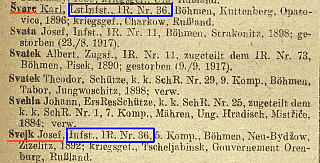
Josef Švejk was no "landšturmák", as opposed to his comrade from IR36, Karel Švarc from Kutná Hora
The general impression is that Jaroslav R. Veselý gathered enough facts to establish some credibility, knew the life story of Hašek in detail, and had met and interviewed Švejk, but then liberally filled the gaps with his own colourful accounts where necessary. Moreover, there is every reason to believe that the core of the story, the connection and friendship between Josef and Jaroslav, is pure fiction. It is therefore unsurprising that established Hašek experts viewed the article with scepticism at the time. Radko Pytlík nevertheless includes the more credible parts in his books, but attaches little importance to the rest.
Sergey Nikholsky's research
Apart from the investigations by Augustin Knesl around 1983, the only serious researcher to follow up the story was the Russian Bohemist Sergey Nicholsky, who devotes about a third of his book News about Hašek and his hero (1997) to it. Nikolsky found archival material confirming some details about Švejk in the k.u.k. Heer and in the Legions. Apart from this, he provides nothing that verifies Veselý's claims that Jaroslav Hašek and Josef Švejk were friends or even knew of each other.
Sergey Nikholsky discusses two other alleged prototypes of Švejk, claims that have been circulating for decades. The first is well known: František Strašlipka. Nikholsky is sceptical about the role assigned to Strašlipka as a model for Švejk, noting that, apart from the storytelling and their position in the army hierarchy, little links them and that their lives were otherwise very different. The second is a little-known story that appeared in Prager Presse on 5 December 1929. It was penned by Maximilian Huppert and introduces a František Švejk. The whole story bears traces of having been adapted from the novel, and no one seems to have taken it seriously, or even been aware of it.
Other Švejks?
Another Josef Švejk also appears in Verlustliste and, like his namesake, had his right of domicile in Nový Bydžov. This person is, however, listed in IR74 and reportedly ended up in Serbian captivity (Niš). Then there is a wood trader of the same name from Karlín who repeatedly placed advertisements in Národní listy in 1909. According to the biographer František Langer (Byli a bylo, 1963), Jaroslav Hašek was an avid newspaper reader who often started with the advertisements, effectively reading papers back to front. Moreover, he had a photographic memory, so if he had seen those advertisements he would surely have remembered them. Jaroslav Šerák has carried out a comprehensive study of families named Švejk, listing numerous people[c].
A curiosity is an advertisement in Národní listy from 1891, in which a Josef Švejk of Salmova ulice No. 14 advertises bukové fošny (beech planks) for sale. This Švejk was a wood trader and lived in the area for only two years, but it is still possible that the 8-year-old Jaroslav Hašek could have heard of him. He also had a son Josef (born in 1878) whom Hašek could have known. That said, the likelihood that this person lent his name to a figure invented 20 years later is remote.
Conclusion
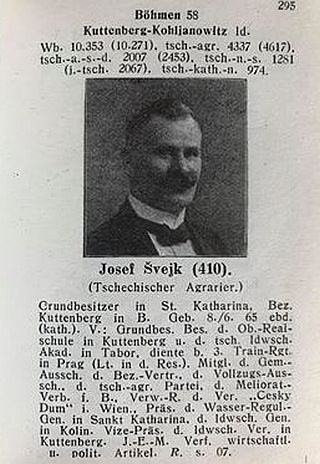
Das Oestrreichische Abgeordnetenhaus 1911, p. 295
© Tom Alner
Although Veselý provided interesting new information and Nikholsky added more through his meticulous research, what we are left with boils down to the following: Josef Švejk, born 22 November 1892 in Dubí (hejtmanství Kladno) indeed lived two doors from U kalicha in 1912. He served briefly with Hašek in the reserve battalion of the Czechoslovak brigade in 1916 and they both continued as Czech volunteers until Hašek left the Legions in March 1918. The photos Veselý provides appear to be authentic, and show an infantryman from IR36, 5th company. This is consistent with Švejk's documents from k.u.k. Heer so we can safely assume that Veselý at least got some of his information and photos directly from Josef Švejk and that he indeed was identical to the 19 year old from Dubí who lived by U kalicha in 1912.
But does this prove that Josef Švejk was a friend of the author and an inspiration for the famous good soldier? Not at all. The information from Veselý's article that is designed to provide the missing link between the two is highly questionable. In fact not a single detail from Veselý's attempt to link Švejk to Hašek has been confirmed, and some of them can be flatly dismissed. Veselý and Nikholsky may have given Švejkologists some alternative perspectives, and a lot of information on Josef Švejk himself, but nothing of value regarding the connection between Švejk and Hašek. This leaves the good soldier from Infanterieregiment Nr. 36 and 3. pluk "Prokopa Velíkeho" as a rather peripheral figure. Peripheral or not, at least we know about his existence!
So who is the most likely person to have lent his name to Švejk? We will never know for sure what Jaroslav Hašek had in mind in 1911 but it is overwhelmingly likely to be the well-known politician Josef Švejk from Kutná Hora district rather than the obscure 19-year old boy who probably didn't even live in Prague at the time the soldier Švejk was conceived. That said it is likely that Jaroslav Hašek could have met or heard of the young Josef Švejk during or after the war and that this somehow rekindled his interest in his 1911 hero, be it in 1917 or 1921. It should also be noted that U kalicha became a theme for Jaroslav Hašek only in 1921. It may be a coincidence, but it is tempting to suggest a link to the neighbour of U kalicha.
Credit: Národní listy, Čech, VÚA, K.k. Reichsrat, Jaroslav Šerák, Jaroslav Veselý, Sergey Nikholskij, Sergey Soloukh
Literature
- Pevnost, [a]
- Agadir, [b]
- Hledání Josefa Švejka v archivech, [c]
- Josef Švejk (politik),
- The unknown Švejk,
- Hašek v předčasných volbách lákal na sloní rypák v rosolu,
- Josef Švejk a ti druzí. 1., Augustin Knesl,1983
- Josef Švejk a ti druzí. 2., Augustin Knesl,1983
- Josef Švejk a ti druzí. 3., Augustin Knesl,1983
- Josef Švejk a ti druzí. 4., Augustin Knesl,1983
- Josef Švejk a ti druzí. 5., Augustin Knesl,1983
- Bukových fošen, ,6.6.1891
- K volbě do řišské rady ve volebním okresu chrudimském, ,14.9.1903
- Übersetzungen in der Landwehr, ,31.12.1895
- Neslýchaný teror agrárního kandidata Švejka, ,12.4.1907
- Když agrárnik Švejk opustil posvícení pro menšinovou schůzi, ,14.9.1909
- Z Kutnohorska, ,14.5.1911 [d]
- Zajímavé válečné setkání, ,3.3.1916
- Jaroslaus Hašek, Einj. Freiw. I. R. Nr. 91., ,15.12.1927
- Historisches vom Švejk, ,5.12.1929
- Haškův přítel Josef Švejk, Jaroslav R. Veselý,7.9.1968
- Švejk Josef, Gemeindevorsteher,
- Švejk Josef, Gemeindevorsteher, ,1909
- Švejk Josef, Grundbesitzer, ,1909-11
- Švejk Josef, Grundbesitzer,
- Prohlídka domobranců, ,20.9.1914
- Verlistliste Nr. 644,
- Švejk Josef,
| a | Pevnost | ||
| b | Agadir | ||
| c | Hledání Josefa Švejka v archivech | ||
| d | Z Kutnohorska | 14.5.1911 |