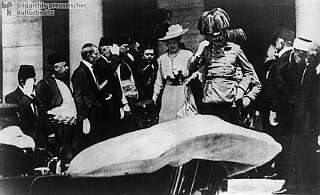
Franz Ferdinand and his wife Sophie leaving Sarajevo Town Hall on 28 June 1914, five minutes before the assassination.
The Good Soldier Švejk is a novel with an exceptionally rich cast of characters. Alongside those who play a direct part in the plot, a great many fictional and real people (and animals) are mentioned throughout the narrative, in Švejk's anecdotes and in the book's idioms and turns of phrase.
This page offers brief entries on the people referred to in the novel, from Napoléon in the introduction to Hauptmann Ságner in the final lines of the unfinished Part Four. The list is sorted in the order in which names first appear. Chapter headings follow Zenny Sadlon's recent translation (1999–2026) and, in most cases, differ from Cecil Parrott's 1973 version.
The Czech quotations are taken from the online version of The Good Soldier Švejk provided by Jaroslav Šerák and link to the relevant chapter. The toolbar provides direct links to Wikipedia, Google Maps, Google Search, svejkmuseum.cz and the novel online.
The names are colour-coded according to their role in the novel, as illustrated by the following examples:
Dr. Grünstein, a fictional character directly involved in the plot.
Fähnrich Dauerling, a fictional character who is not part of the plot.
Heinrich Heine, a historical person.
Note that many seemingly fictional characters are inspired by real people. Examples include Oberleutnant Lukáš, Major Wenzl and many others. These are still listed as fictional, since they are literary creations only partly inspired by their similarly named 'models'.
Military ranks and other titles related to Austrian officialdom are given in German, in accordance with the terms used at the time (explanations in English are provided as tooltips). This means that Captain Ságner is still referred to as Hauptmann, even though the term is now obsolete and has been replaced by Kapitän. Civilian titles denoting profession, etc., are translated into English. This also applies to ranks in the nobility where a direct translation exists.
Heine
is quoted by Feldkurat Katz in a poetic moment after a long and cheerful day.
Background
Heine
(born Harry, later christened Christian Johann Heinrich), was one of the most important German poets and journalists in the 19th century. He is often referred to as the last romantic poet and one who also survived the era. As a critical and politically engaged journalist and satirist, he was as much admired as feared. His Jewish background also underlined his role as an Aussenseiter (outsider) with many enemies.
Sterne der Satire
On 15 September 2015 Heine posthumously shared an unlikely stage with Jaroslav Hašek. Both were on this day inducted in the memory plaque gallery of Sterne der Satire in Mainz, as stars no. 78 and 79. respectively. Present on the occasion was Richard Hašek (grandson of the author) and several notabilities from German political and cultural life. The 80th and final star in the series was awarded to the comedian Dieter Hallervorden.
Die Lore-Ley
His most famous poem was Die Lore-Ley (1824). In [4.1] the first two lines are quoted by the drunk sergeant who interrogates Švejk in Dobromil.
Ich weiß nicht was soll es bedeuten,
Dass ich so traurig bin;
Ein Märchen aus alten Zeiten,
Das kommt mir nicht aus dem Sinn.
Quote(s) from the novel
[I.12] Polní kurát rozděloval své povinnosti s hýřením a přicházíval velice zřídka domů, umazaný, nemytý, jako kocour, když se mrňouká a dělá své výlety po střechách.
Při návratu, mohl-li se vyjadřovat, hovoříval ještě se Švejkem, než usnul, o vznešených cílech, o zápale, o radosti z myšlení. Někdy se také pokoušel mluvit ve verších, citovat Heina.
Susanna in the bath
decorates the wall above the bed of Feldkurat Katz and this is pointed out to the pious field chaplain when he complains there are no crucifixes in the room.
Background
Susanna in the bath
was a biblical character from the Book of Daniel. This part of the book is so-called "apochrypal" (of disputed origin) and not included in Protestant bibles. Susanna has been painted by many artists - Rembrandt, Rubens og van Dyck being amongst them. She is also the theme of a composition by Händel. Several theatre plays based on the theme have been performed over the years, some of them considered quite daring at the time.
The story revolves around Susanna, the beautiful wife of Joachim. Two elders (judges) get infatuated with her and try to blackmail her to have sex with them. One day when she is taking a bath they carry out the threat but she rejects their advances. They subsequently accuse her of infidelity and report her. She is given a death sentence but after prayers by Susanna God intervenes, informs the prophet Daniel about the real situation, and the case is reopened. The two elders are now interrogated separately and their explanations turn out to differ. The result is that Susanna is cleared and her two tormentors executed.
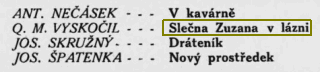
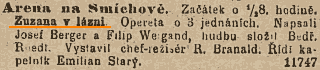
Jaroslav Hašek surely knew this story very well. One of his friends from Strana mírného pokroku v mezích zákona (Quodo Maria Vyskočil) for instance penned a story called "Miss Susanna in the Bath". It was published by publisher Vilímek in 1911. Around the same time a theatre play based on Susanna was performed in Smíchov.
Hašek also wrote the story Biblický případ koupající se Zuzany v novém světle that was never published during his lifetime. It is set in Samara and presumably it was written after the author's return from Russia, i.e. in 1921 or 1922.
Quote(s) from the novel
[I.12] Dnes přišel svého kolegu Katze uvésti na pravou cestu a promluvit mu do duše, což začal tím, že poznamenal: „Divím se, že u vás nevisí krucifix. Kde se modlíte breviář? Ani jeden obrázek svatých nezdobí stěny vašeho pokoje. Co to máte nad postelí?“
Katz se usmál: „To je ,Zuzana v lázni’ a ta nahá ženská pod tím je moje stará známost.
Papin
is mentioned indirectly by Feldkurat Katz in his description of the modern hell where pressure-boilers play a part in inflicting sufferings on the damned.
Background
Papin
was a French physicist, mathematician and inventor who is best known for having invented the pressure-boiler (machine à vapeur). It is this device that is mentioned in The Good Soldier Švejk and it was invented in 1679 in London (Papin had left France in 1675).
Quote(s) from the novel
[I.12] To jest místo obyčejných kotlů se sírou pro ubohé hříšníky papinské hrnce, kotle s velkou atmosférou, hříšníci se smaží na margarinu, rožně s elektrickým pohonem, po miliony let přejíždějí přes hříšníky stoje na válcování silnic, skřípání zubů obstarávají dentisti zvláštními přístroji, kvílení se zachycuje do gramofonů a desky se posílají nahoru do ráje k obveselení spravedlivých.
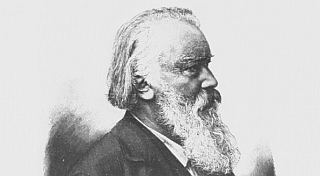
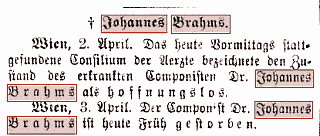
Brahms
was, according to Feldkurat Katz, played so frequently in paradise that the righteous in the end wanted a transfer to hell.
Background
Brahms
was a German composer, conductor and pianist. He was discovered in 1853 by Robert Schumann who wrote an ecstatic article about the young musical genius.
His big breakthrough happened in 1868 with Ein deutsches Requiem. Brahms spent 20 years on his first symphony but eventually more were produced. From 1872 until his death he lived in Vienna.
Quote(s) from the novel
[I.12] To jest místo obyčejných kotlů se sírou pro ubohé hříšníky papinské hrnce, kotle s velkou atmosférou, hříšníci se smaží na margarinu, rožně s elektrickým pohonem, po miliony let přejíždějí přes hříšníky stoje na válcování silnic, skřípání zubů obstarávají dentisti zvláštními přístroji, kvílení se zachycuje do gramofonů a desky se posílají nahoru do ráje k obveselení spravedlivých. V ráji účinkují rozprašovače kolínské vody a filharmonie hraje tak dlouho Brahmsa, že raději dáte přednost peklu a očistci.
Literature
Neue Bahnen, Neue Zeitschrift für Musik,28.10.1853
Saint Augustine
is mentioned in the anecdote of Švejk about the church servant from Vlašim who, like Augustine, did not believe in the Antipodes. The quote in question was: "damned is he who believes in the Antipodes". The target of the anecdote was the pious field chaplain who unannounced arrived at the door of his colleague Feldkurat Katz to have a stern word with him.
Background
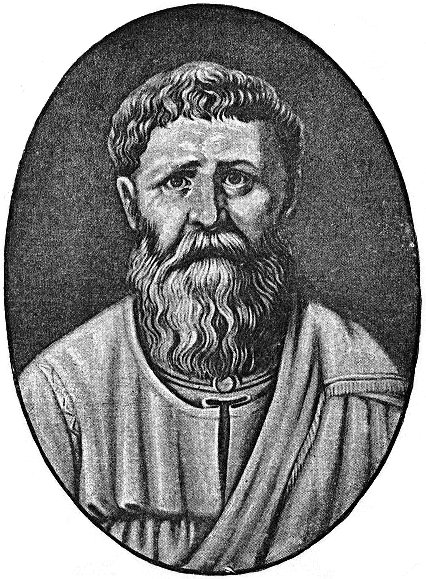
Saint Augustine
was a Church father and philosopher from North Africa and one of the greatest of the ancient theologians. He was regarded a saint soon after his death. In "De civitate Dei" he reveals his scepticism about the Antipodes:
Quod vero et Antipodes esse fabulantur, id est, homines a contraria parte terrae, ubi sol oritur, quando occidit nobis, adversa perdibus nostris calcare vestigia, nulla ratione credendum est ...
Quote(s) from the novel
[I.12] „U Vlašimě byl, poslušně hlásím, pane feldkurát,“ řekl Švejk, „jeden děkan a ten měl, když mu jeho stará hospodyně utekla s klukem i s penězi, posluhovačku. A ten děkan na stará kolena dal se do studování svatýho Augustina, kterýmu říkají, že patří mezi svaté otce, a dočet se tam, že kdo věří v protinožce, má bejt prokletej.
John the Baptist
is mentioned when the pious field chaplain asks Feldkurat Katz if he believes that the thumb of John the Baptist is kept U Piaristů and if he believes in God at all.
Background
John the Baptist
is a character from the New Testament who baptised Jesus Christ in the river Jordan. He was also a martyr, having been executed at the order of herodes.
He also plays a role as a prophet in Islam, Judaism and the Bahai religion.
Quote(s) from the novel
[I.12] Mžouraje očima, otázal se Katze: „Vy nevěříte v neposkvrněné početí panny Marie, nevěříte, že palec sv. Jana Křtitele, který se chrání u piaristů, je pravý? Věříte vůbec v pána boha? A když nevěříte, proč jste polním kurátem?“
Saint Joseph
is invoked by the religious field chaplain when he after several potent swigs bangs his fist on the table and proclaims that he regards Joseph a saint.
Saint Joseph
is a figure from the New Testament who was married to the Virgin Mary and thus served the role as father of Jesus Christ. He is regarded a saint in Orthodox, Catholic and Anglican Christianity.
Quote(s) from the novel
[I.12] Uhodil pěstí do stolu, až láhve poskočily: „Bůh je vznešená povaha, cosi nadpozemského. Je čestný ve svých záležitostech. Je to slunný zjev, to mně nikdo nevyvrátí. I sv. Josefa si vážím, všechněch svatých si vážím, až na sv. Serapiona. Má takové ošklivé jméno.“
Saint Serapion
was not held in esteem as a saint by the religious field chaplain because he had such a repulsive name.
Background
Saint Serapion
was a monk and soldier from the age of the Crusades who suffered martyrdom at the hands of the Moors and was later canonized. He was a member of the Mercedarian Order for Redemption of Captives whose goal was to release Christian prisoners in Moslem captivity. The background for this martyrdom was that he offered himself as a hostage in Alger in a prisoner exchange deal, but when the Moslem captives were not released in time he was mutilated and killed. Serapion was of British origin and probably born in London.
Quote(s) from the novel
[I.12] Uhodil pěstí do stolu, až láhve poskočily: „Bůh je vznešená povaha, cosi nadpozemského. Je čestný ve svých záležitostech. Je to slunný zjev, to mně nikdo nevyvrátí. I sv. Josefa si vážím, všechněch svatých si vážím, až na sv. Serapiona. Má takové ošklivé jméno.“
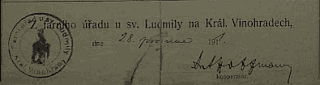
From Hašek's marriage certificate, signed 28 December 1911
Saint Ludmila
is also mentioned by the pious field chaplain during the religious debate with Feldkurat Katz.
Background
Saint Ludmila
was, according to legend, a Czech princess and married to the first Christian ruler of Bohemia, Bořivoj I of the Přemysl dynasty. She was the grandmother and custodian of Sankt Václav. Ludmila is said to have been murdered on orders from her daughter-in-law, and became the first Czech saint.
Ludmila is an important person in the borderland between Czech mythology and history. Antonín Dvořák composed an oratorio to her honour, lyrics provided by Vrchlický. A red wine from Mělník is also named after her.
Ludmila also had a church in Vinohrady named after her: Kostel sv. Ludmily at Purkyňově náměstí (now Náměstí míru). It was here that Jaroslav Hašek married Jarmila Mayerová on 23 May 1910.
Quote(s) from the novel
[I.12] „Sv. Ludmilu mám rád, i sv. Bernardina,“ pokračoval bývalý katecheta, „ten zachránil moc poutníků ve sv. Gotthardě. Má na krku láhev s koňakem a vyhledává zapadlé sněhem.“
Saint Bernhard
was held in high esteem by the religious field chaplain. Here he is called St. Bernardin but there is little doubt that the field chaplain refers to Saint Bernhard because he saved many pilgrims by Sankt Gotthard.
Background
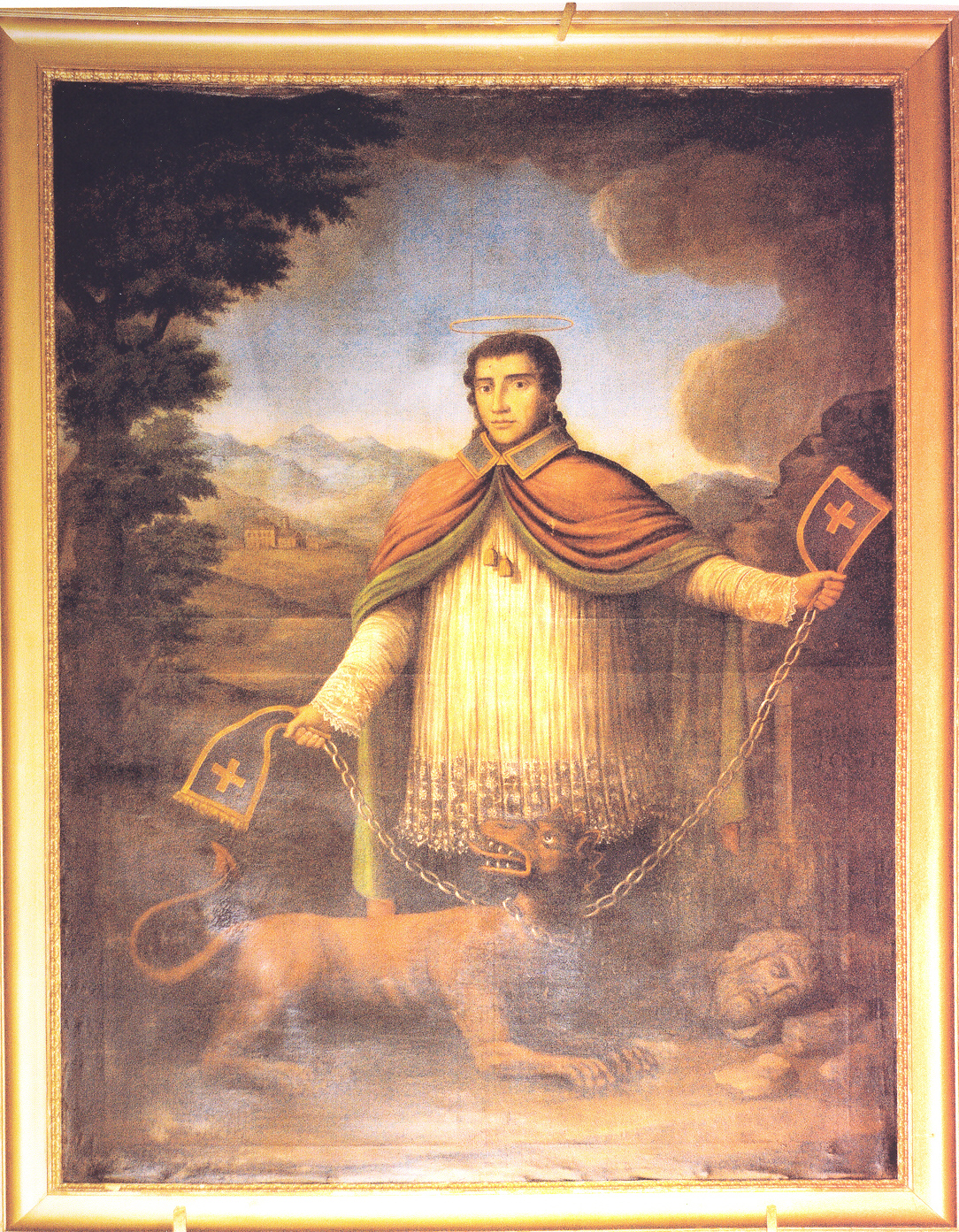
Saint Bernhard
(Bernard of Aosta, Bernard of Menthon or Bernard of Mont-Joux) was a French missionary who operated in the Alpine region. He is the patron saint of Alpine dwellers and mountaineers. The chronological details of his life are unclear, including year of birth and death.
Quote(s) from the novel
[I.12] „Sv. Ludmilu mám rád, i sv. Bernardina“, pokračoval bývalý katecheta, „ten zachránil moc poutníků ve sv. Gotthardě. Má na krku láhev s koňakem a vyhledává zapadlé sněhem.“
Herod
appears in the story through unkind words uttered by the God-fearing field chaplain who hates him.
Background
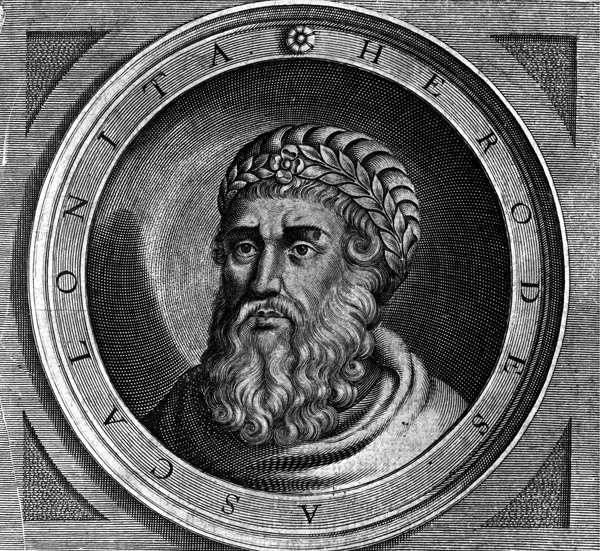
Herod
was a Roman vassal King of Judea, Galilee, Samara and the surrounding areas. Many historians regard him as an effective ruler who completed several large building projects, but he was also known as ruthless and tyrannical. He had several members of his family executed, amongst them one of his wives.
In the New Testament
Herodes is best known through the Bible and the role he played after the birth of Jesus Christ. According to Matthew's gospel he gave the order to murder all boys in Betlehem of less than two years age. This was after the newly born Jesus, his perceived rival as "king of the Jews", had been brought into safety by his father Saint Joseph.
Quote(s) from the novel
[I.12] Zábava dostala jiný směr. Nábožný polní kurát počal mluvit páté přes deváté: „Mláďátek si ctím, mají svátek 28. prosince. Herodesa nenávidím.
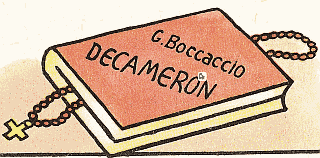
Boccaccio
is mentioned because Švejk put Bocaccio's Decameron in the hand of the pious field chaplain who was legless and had fallen asleep. The soldier found the book on the night table of Feldkurat Katz.
Background
Boccaccio
was an Italian writer and poet. He is best known as author of the The Decameron, the book that is mentioned here. He is regarded as one of the all time greats of Italian literature.
The Decameron
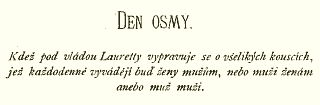
This book was by some distance Boccaccio's most famous work. The plot is set during the times of the Black Death (1348) in the surroundings of Florence. It is a collection of 100 short stories, told by 10 people who have fled the city due to the plague. Each tell one story a day over 10 days, some of them very daring for their time. This was partly due to sexually explicit content, moreover satire directed at the church and its institutions.
The Decameron is considered a key work in European literature, inspiring, amongst others, Geoffrey Chaucer and later Miguel de Cervantes and Lope de Vega.
The book was banned and censored on several occasions during medieval times, but more surprisingly the US postal services were from 1873 required by law not to ship it. The ban was lifted as late as 1926.
Translations
The novel has been translated into numerous languages, English translations abound. The first known was in 1620, and the first complete version was published in 1886 (translated by John Payne), and the most recent one appeared as late as 2013. The first Czech translation was published in 1881 (translated by Josef Fl. Karafiát), and in 1897 a new one followed.
Hašek and the Decameron
There are some striking similarities between Jaroslav Hašek's novel and Decameron. They are both satirical books, have been banned, and are fragmented in their composition. Another curious similarity is the large number of facts that are embedded: the Decameron mentions numerous places, people and institutions, just like Hašek's novel does.
Fifty years after Hašek's death three volumes of his short stories were published, exploiting the name of Boccaccio's famous book: Dekameron humoru a satiry (1968), Druhý Dekameron (1979) and Třetí dekameron: Reelní podnik (1977).
Quote(s) from the novel
[I.12] Nakonec ho uložili do postele. Než usnul, prohlásil, vztyčuje k přísaze pravici: „Věřím v boha otce, syna i ducha svatého. Přineste mně breviář!“
Švejk mu strčil do ruky nějakou knihu ležící na nočním stolku, a tak nábožný polní kurát usnul s „Decameronem“ G. Boccaccia v ruce.
Literature
Dekameron, Giovanni Boccaccio - Arnošt Procházka,1938




 czdeennnno
Search
czdeennnno
Search