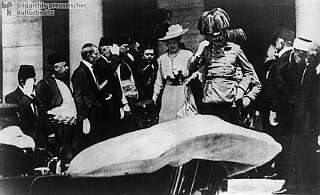
Franz Ferdinand and his wife Sophie leaving Sarajevo Town Hall on 28 June 1914, five minutes before the assassination.
The Good Soldier Švejk is a novel with an exceptionally rich cast of characters. Alongside those who play a direct part in the plot, a great many fictional and real people (and animals) are mentioned throughout the narrative, in Švejk's anecdotes and in the book's idioms and turns of phrase.
This page offers brief entries on the people referred to in the novel, from Napoléon in the introduction to Hauptmann Ságner in the final lines of the unfinished Part Four. The list is sorted in the order in which names first appear. Chapter headings follow Zenny Sadlon's recent translation (1999–2026) and, in most cases, differ from Cecil Parrott's 1973 version.
The Czech quotations are taken from the online version of The Good Soldier Švejk provided by Jaroslav Šerák and link to the relevant chapter. The toolbar provides direct links to Wikipedia, Google Maps, Google Search, svejkmuseum.cz and the novel online.
The names are colour-coded according to their role in the novel, as illustrated by the following examples:
Dr. Grünstein, a fictional character directly involved in the plot.
Fähnrich Dauerling, a fictional character who is not part of the plot.
Heinrich Heine, a historical person.
Note that many seemingly fictional characters are inspired by real people. Examples include Oberleutnant Lukáš, Major Wenzl and many others. These are still listed as fictional, since they are literary creations only partly inspired by their similarly named 'models'.
Military ranks and other titles related to Austrian officialdom are given in German, in accordance with the terms used at the time (explanations in English are provided as tooltips). This means that Captain Ságner is still referred to as Hauptmann, even though the term is now obsolete and has been replaced by Kapitän. Civilian titles denoting profession, etc., are translated into English. This also applies to ranks in the nobility where a direct translation exists.
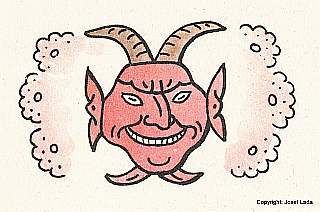
The Devil is mentioned 42 times in The Good Soldier Švejk.
The Devil
name is first invoked when the interrogator at c.k. policejní ředitelství gets uptight about Švejks reassurance that his exclamation: "Long live the Emperor, we'll win this war!" was not meant ironically. His name occurs repeatedly, mostly in the form of Czech and German swear words.
Background
The Devil
is a mythological figure in numerous religions; symbolising evil. Alternative names are Satan, Lucifer, Mephistopheles and Beelzebub. In monotheist religions, the Devil is generally considered the opposite of God. He presides in Hell as opposed to God who rules in Heaven. The Devil has a bad name, he is invoked whenever one seeks to convey a negative association, typically uttered through so-called swearwords. As a symbolical expression, the word devil through its many variations, may be one of the most used ever.
Quote(s) from the novel
[I.6] Vem vás čert, Švejku,“ řekla nakonec úřední brada, „jestli se sem ještě jednou dostanete,tak se vás vůbec nebudu na nic ptát a poputujete přímo k vojenskému soudu na Hradčany. Rozuměl jste?
[I.14.6] Zatímco Švejk koupal Maxa, plukovník, bývalý jeho majitel, strašně doma láteřil a vyhrožoval, že postaví toho, kdo mu psa ukradl, před válečný soud, že ho dá zastřelit, pověsit, zavřít na dvacet let a rozsekat. „Der Teufel soll den Kerl buserieren,“ ozývalo se v bytě plukovníka, až se třásla okna, „mit solchem Meuchelmördern werde ich bald fertig.“
[II.5] "To byste se byl moh také opovážit, burcovat mne kvůli každej hlouposti, když je na to dost času až ráno. Wieder eine Besprechung, der Teufel soll das alles buserieren! Pověste sluchátko, zavolejte mně k telefonu Vaňka."
Encyklopedie pro milovníky Švejka, Milan Hodík,1999
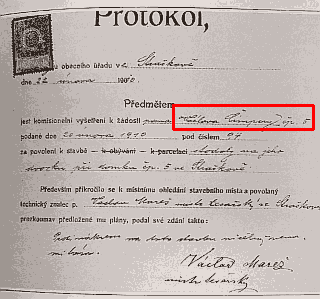
Čimpera
owned a piece of land in Straškov no. 5 that he advertised for sale in a newspaper found at U kalicha. Švejk read the advert out loud to demonstrate his total lack of interest in the attention of detective Bretschneider who again sought to trap him.
Background
Čimpera
no doubt refers to VáclavČimpera who indeed lived in Straškov no. 5 in 1910! This is information from Encyklopedie pro milovníky Švejka, II., Hodík a Landa, 1999. The document on the picture is from 22 February 1910. It is not known why (or whether) Čimpera later sold the property[a].
Quote(s) from the novel
[I.6] Švejk sňal s věšáku nějaké noviny a prohlížeje si zadní stranu inserátů, ozval se: „Tak vida, tenhle Čimpera v Straškově č. 5, p. Račiněves, prodá hospodářství s třinácti korci vlastních polí, škola a dráha na místě.“ Bretschneider nervosně zabubnoval prsty a obraceje se k Švejkovi řekl: „To se divím, proč vás to hospodářství zajímá, pane Švejku.“
Mařena
was a woman who the porter at the night café Mimosa had brought home. This happened when Švejk got back from his time in custody and discovered that Mrs. Müllerová had rented his room out, and that in his bed slept the night porter and the mentioned woman. Mařena contributed to the novel with a single utterance when she dressed down Švejk with the select words: "you son of an Archbishop!"
Quote(s) from the novel
[I.6] „Já jsem chtěl spát do osmi večer,“ zaraženě ozval se portýr, navlékaje kalhoty, „já platím denně z postele dvě koruny té paní a můžu si sem vodit slečny z kavárny. Mařeno, vstávej!“
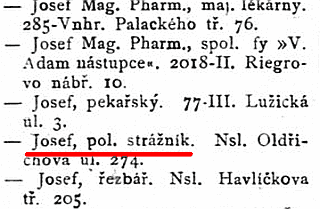
Kalous
was a police agent who, like detective Bretschneider, bought dogs from Švejk in order to lure something compromising out of him. He got nowhere and soon disappeared from the plot.
Background
The detective may have been inspired by Josef Kalous, a policeman in Nusle who is listed in the address book of 1910.
In 1913 Karikatury printed a story by Jaroslav Hašek called The detective Mr. Kalous[a]. It was signed Richard Mayer, one of the many pseudonyms that Hašek used.
Quote(s) from the novel
[I.6] Pak tam šel koupit psa detektiv Kalous a vrátil se s vyjevenou potvorou, připomínající hyenu skvrnitou, s hřívou škotského ovčáka, a v položkách tajného fondu přibyla nová: D...90 K.




 czdeennnno
Search
czdeennnno
Search