




 | Oberleutnant Wurm, Johann |  |
| *22.3.1884 Smíchov - †? 19?? | ||
| Search | ||
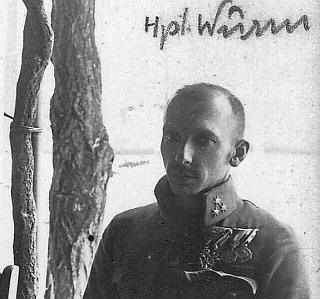
From Jednadevadesátníci.
© Jan Ciglbauer, 2018.

Rangliste. Bestand Karl Wagner, Kriegsarchiv.
© ÖStA

Jan Ev. Eybl, 16.3.1915.
© SOkA Beroun
Konskripce 1911
,1851 - 1914
© NAČR

, 1915

,15.2.1915
Wurm was an obrlajtnant in Budějovice whom Švejk told Feldkurat Martinec about during a session of spiritual consolation in the cell in Przemyśl. It was a very long anecdote about the plight of officer cadets, who were neither officers nor ordinary soldiers. They were not allowed to eat in any of the canteens, as Wurm forbade them to use the soldiers' canteen because he considered it beneath their dignity. Nor were they permitted in the officers' canteen, so they were left in limbo.
Background
Wurm was an officer in k.u.k. Heer, an Oberleutnant in Infanterieregiment Nr. 91 until 1 July 1915, and then promoted to Hauptmann. Apart from almost certainly being the person Švejk talks about in the cell in Przemyśl, Wurm may also have partly inspired the grotesque Fähnrich Dauerling.
Eybl's diary
Field chaplain Jan Eybl noted in his diary that Wurm commanded a march company that arrived at the front at Jaworzec in the Carpathians on 16 March 1915. The timing indicates that it belonged to the 7th march battalion. Ersatzbataillon IR. 91 was still located in Budějovice at the time, so it is very likely that Hašek knew Wurm, as the former served there from 17 February and the 7th march battalion probably departed around 8 March. Eybl also noted that Wurm was a nephew of Field Marshal Wenzel Wurm (he was mistaken regarding the rank: Wurm was Feldzeugmeister in 1915).
Ranglisten und Schematismus
Only one person on the list of officers (Ranglisten) from IR. 91 fits Eybl's description: Johann Wurm, born in 1884 in Prague. The list shows that he was promoted to captain on 1 July 1915, so in March his rank was Oberleutnant, exactly as Jan Eybl noted. He had attained this rank on 1 November 1912 and had served as a lieutenant since 1 May 1907. In his early career he served in Feldjägerbataillon Nr. 7 and, from 1907, in Feldjägerbataillon Nr. 22.
Police records
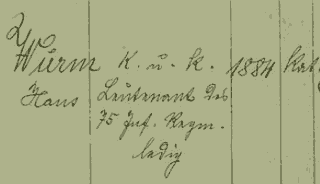
No Johann Wurm born in 1884 is listed in the Prague police records, but the details of a certain Hans Wurm fit well. The names Hans and Johann were used somewhat interchangeably (Hans Bigler is another officer who appears under both names). Lieutenant Wurm served with Infanterieregiment Nr. 75 in 1911 and lived in Vinohrady Hálkova tř. 379/12 (today Londýnská 379/73).
Before the war
With the help of newspaper reports, it has been possible to piece together more details of Wurm's career beyond those already mentioned. On 22 May 1909 he was involved in an incident in Jindřichův Hradec where, during a clash with a Sokol instructor, he drew his sabre and slashed his opponent's hand.
Wurm was the son of factory manager Josef Wurm, who ran an oven and iron foundry in Podbořany (Podersam). The German press used the names Hans and Johann interchangeably, although Johann was more common. The Czech press predominantly used Jan, although Hans also occurred.
Serving in IR. 91
Newspaper notices show that in spring 1914 he was transferred from Infanterieregiment Nr. 75 to IR. 91/1st battalion. After the outbreak of war he served with this battalion in southern Dalmatia and Serbia, where he was commander of the 4th company. Some time between 6th and 8 October 1914 he was wounded (shot in the foot). He was taken to hospital and was also awarded the Signum Laudis. According to a list of wounded soldiers, he was sent to a reserve hospital in Kroměříž (Kremsier) in Moravia. Prager Tagblatt noted that on 7 February 1915 he appeared at a celebration for decorated officers in Dirnfellern (Suché Vrbné) near Budějovice, where the 7th march battalion was exercising. It was added that he had been severely wounded but was still returning to the front.
Details of the rest of the war are available only in fragments. A brief note in Prager Tagblatt 21 November 1915 reveals that he was decorated for the second time for his conduct in battle on 24 September 1915. This related to the battle at Khorupan, where Jaroslav Hašek, František Strašlipka, Emanuél Michálek and hundreds of their fellow soldiers from IR. 91 were captured. In 1916, he was decorated for the third time and was still with IR. 91.
Arrested as a spy

, 11.10.1922
In May 1921, Wurm entered the Czechoslovak army as a staff captain at the Ministry of Defence (MNO), where he acted as a liaison officer with Parliament, with particular responsibility for German members. He was arrested on 7 October 1922 on suspicion of espionage. During the same operation, two other officers, Gustav Wolf and Georg Nowakowski, had already been detained. The case was tried before a military court in December.
The trial

, 11.12.1922

,12.12.1922
Court proceedings commenced on 11 December at 9 in the morning and were conducted before the military court at Hradčany (see Vojenský soud Hradčany). Parts of the trial were closed to the public. The prosecution presented a 24-page indictment against the three, which broadly concerned accusations of spying and treason. Wurm was accused of having passed on a classified document in exchange for a payment of 3,000 crowns. The recipient was Jaroslav Philipp, a former k.u.k. officer and now an agent in Polish service. Wurm was also suspected of having passed on additional classified material to the same contact. Wurm was alleged to have been in contact with the committed monarchist Philipp from the time he entered the service of the Czechoslovak Army.
In total, 13 people were called to testify and provided 91 pages of witness accounts. In addition, experts in psychiatry, handwriting and photography testified. The first person to be questioned was staff captain Wurm. During questioning on 11 December, he admitted having passed sensitive material to Philipp, but claimed not to have known what the recipient intended to do with it. He admitted having accepted 3,000 crowns for the documents, as he was in a difficult financial situation.
,14.12.1922
The next day, the proceedings concerned only Wolf and Nowakowski, but on 13 December Wurm's name was mentioned during the interrogation of witnesses. It was said that "although he was of Czech origin, he harboured German national political convictions". Another witness, a relative of Wurm, described the accused as "power-mad, unsympathetic and not well liked, even amongst comrades".
Witnesses who knew him from his time in k.u.k. Heer described him as a brutal, vain and inconsiderate officer, especially towards Czech soldiers. Examples of his cruelty were given: he once punished his horse with two days' starvation for having thrown him off, and also shot his own dog when the animal did not obey.
During the afternoon court proceedings on 13 December, a psychiatric expert stated that "Wurm could be described as physically and spiritually degenerate", but it could not be concluded that he was (or had been) mentally ill. It was also revealed that Wolf's confession upon his arrest led directly to Wurm's detention.

, 16.12.1922
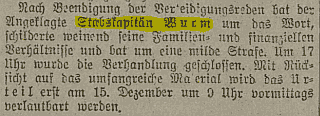
Wurm's defender, Major Řehák, argued for a complete acquittal. He stated that "it was inconceivable that Wurm would jeopardise his entire existence for such a small amount", and that "Wurm was an accommodating person who acted under pressure from Philipp". The court should consider the following mitigating circumstances: a previously spotless record, the difficult situation of the accused (financially and mentally), and his family. Wurm also made a final appeal, during which he wept and explained the difficult situation he and his family were in, and asked for a lenient verdict.
The verdict was delivered on 15 December and all three defendants were convicted. It was concluded that they all betrayed their country for financial reasons, which resulted in a harsher sentence than if their motives had been national or political. Wurm was given four and a half years under harsh conditions: fasting once a month and one month in solitary confinement in each half-year. He was also deprived of his officer's rank and lost the right to vote while imprisoned. Wurm was sent to Terezín to serve his sentence. Nowakowski was sentenced to eight years and Wolf to three.
Information from the press

,14.12.1922
Newspaper reports from the trial revealed further details about Jan Wurm (as he was called in Czech). He was born in Smíchov 22 March 1884 and attended German schools, including Prager Infanteriekadettenschule. He enlisted in the army in 1904 after having served as a one-year volunteer. He declared his nationality as German but spoke Czech well. He had three children who attended German schools. At the time of the court case, the family lived in Dejvice in a flat belonging to his wife. This must have been his second wife, because his first wife Mathilde (born Hartmann) died 16 October 1918 at the age of 29.
Venkov, Prager Tagblatt and Budweiser Zeitung confirm Eybl's information that he was a nephew of Colonel General Wenzel Wurm. Venkov adds that the latter committed suicide (he died in Vienna 22 March 1921), but Lidové noviny and Innsbrucker Nachrichten wrote that he died from natural causes. Budweiser Zeitung astonishingly claimed that Wurm was Czech, and that both his father and his famous uncle were Czech chauvinists and hostile to Germans.
Registration sheet

The registration documents of his father finally shed light on Wurm's background. He was the son of Josef Wurm, born in Penzing by Vienna 17 March 1857. His mother was Karolina, born Schück in 1860. His parents married in 1881 and Johann Wurm was born on 22 March 1884 in Smíchov. He had one sister, Karolina, born in Prague 3 December 1882. His grandfather Josef was an Oberleutnant. The family moved to Nové Strašecí in 1892, and then to Podbořany. Until then they had lived in Vinohrady.
Unknown fate
What happened to Wurm after he was released from prison is not known. In the summer of 1932 it was reported that he attended a gathering of war veterans in Volary (Wallern). He was still alive in 1938, and spoke during a meeting of former front soldiers in Vimperk (Winterberg) on 13 or 14 August that year. He would therefore certainly have witnessed the German annexation of Sudentenland a few months later. If he was still alive in 1945, he was probably expelled from Czechoslovakia.
The very last mention of him that has been found so far is from Budweiser Zeitung 14 February 1940. Again, it was a report from a gathering of war veterans (now under the umbrella of the Nazi party), but this time it was no longer Wurm himself who spoke, but others who talked about him. This suggests that he may already have died.
It is not known whether Wurm continued to live in Prague after his release. Three Jan Wurm are listed in the address book from 1937, but it is impossible to tell whether any of them was identical to the former officer. None of the three lived in Dejvice.
Military archives

Wurm was often ill during the war.
© VÚA

Extracts from his career description in 1915 and 1916.
© VÚA

From the Czechoslovak army.
© VÚA
Recent investigations (VÚA, 22 November 2018) of Wurm's documents from k.u.k. Heer confirm much of what we know from other sources, and also provide additional details. Here, however, we focus on details concerning IR. 91 during the war, and briefly on post-war Czechoslovakia.
Wurm served with 1st battalion in Dalmatia and Serbia from the outbreak of war. He was wounded on 2 October 1914 and did not return to the front until he joined the 7th march battalion. This unit left Budějovice on 8 March 1915 and, on arrival in the Carpathians, he assumed command of the 14th field company. He fell ill with pneumonia and typhus on 2 April, and spent some time in a hospital in Kroměříž. From 10 May he worked at the draft board of Infanterieregiment Nr. 75. From 26 July 1915 he was back with IR. 91 and the 14th march battalion. From 19 September he was again in the field, now near Khorupan. Wurm took part in the battle here five days later, and was transferred with the regiment to the Isonzo-front in mid November.
On 10 January 1916 he fell ill again and after a week in hospital in Laibach (Ljubljana) he was transferred to Bruck, where he took command of IR. 91 1. Ersatzkompanie. He served there until 14 April 1916, when he was transferred to k.k. Landwehr recruitment board no. 3 in Prague. From this period, his documents reveal that he again volunteered for service at the front. His application, however, was rejected because his health was poor and the regiment also needed experienced instructors behind the lines.
From 8 July 1916 he commanded the 23rd march battalion and on 29 August they left for the front. On 8 February 1917 he reported ill and was transported to a hospital in Ljubljana; after recuperating, he again served at a draft board until 20 June, presumably in Prague. Until 3 December he was battalion commander with IR. 91/1st battalion and then at the 28th Rifle Regiment, 3rd battalion (k.k. Landwehr). He then remained in hospital in Prague until 10 April 1918, again with lung problems. From 30 April he served with Jägerregiment Nr. 137, the machine gun section.
The records reveal details about his career in the Czechoslovak army, and these correspond well to what was written in newspapers during the court case. They also show that he did not serve out his prison term, as he was released on probation after three years. His three children were born in 1912, 1914 and 1916 respectively, two daughters and one son. The verdict in the spy case was accurately reported in the newspapers. There is no additional information that can shed light on his fate after he was released from prison.
Devil dressed as a human

, 15.9.1937
The recently published book "Jednadevesátníci" (Jan Ciglbauer, 2018) casts a dark shadow on Wurm as both a person and an officer, and largely confirms the damning testimony given during the spy trial in December 1922. Ciglbauer notes that Wurm's name appears strikingly often in the notes and diaries of veterans from IR. 91, and in the worst possible light.
For instance, the book refers to an article in the magazine Kamarádství from 1937, where J. Hospodářský, a former soldier from IR. 91, describes Wurm as an unusually brutal officer, abnormal in his behaviour. The whole regiment feared and hated him, including his fellow officers. As commander of 1. Erstatzkompanie in Királyhida in 1916 he once mistreated his horse at Batailionsraport after it became restless. In addition, he "sentenced" the animal to two days in the stables without food and water. He also once had his wife escorted away by four armed soldiers when she entered the training ground, where civilians were strictly forbidden during exercises. He was reported to have shot soldiers for trifles, and once had his servant tied up for two hours because he failed to bring him water in time. Hospodářský describes Wurm as "a devil dressed as a human, in uniform".
The arrested horse
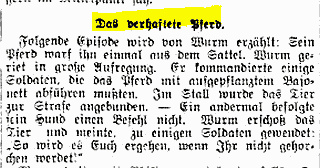
The arrested horse
,14.12.1922
The story of the horse also appeared in newspapers around the time of the spy trial, as witness testimony.
The similarities between Wurm and the fictional character Fähnrich Dauerling are striking, at least in the way the two tyrants treated ordinary soldiers. Jaroslav Hašek, however, only crossed paths with Wurm for three weeks in early spring 1915 and again briefly in the autumn, and they did not serve in the same companies. Still, the author must have heard about Wurm's antics, and may have drawn inspiration from them when creating his grotesque Dauerling figure.
Jan Morávek

Morávek put captain Wimmer in an undeservedly poor light.
, 1924
In his series "Jaroslav Hašek - the Good Soldier Švejk" (Večerní České slovo, 1924) Jan Morávek mentions a captain Wimmer who was replaced by Rudolf Lukas as commander of Hašek's march company shortly before they were transferred from Budějovice to Királyhida. Lukas assumed command of the 4th company of XII. Marschbataillon on 1 June 1915, and Ersatzbataillon IR. 91 were transferred to Bruck the same day. Wimmer allegedly tyrannised the soldiers and subjected his horse to disciplinary measures.
A certain captain Otto Wimmer did serve in IR. 91, but it is unlikely that the regiment was burdened with two such lunatics. Jan Morávek adds that "Wimmer appeared in the newspapers about a year ago", which roughly matches the timing of the spy trial (Morávek had his series published in September 1924). It is therefore likely that Morávek mixed up Wurm with Wimmer, thereby undeservedly tainting the latter as a brutal psychopath. Wurm's military service record, however, reports him as being on sick leave at the time. One explanation is that Wimmer was indeed the person Rudolf Lukas replaced, but that Morávek somehow swapped Wimmer and Wurm later.
Petr Novák
V edici je Eyblův záznam z 16. března přepsána takto: "Spal v márnici. Naše vojsko je zahrabáno, na útok nepomýšlí. Proti nám stojí čerstvé vojsko, minský a jekatěrinoburský pluk. Došla marškumpanie, kterou vedl nadporučík Wurm, synovec Feldmaršála Wurma."
Quote(s) from the novel
[IV.2] Měli jsme jich tam tenkrát pět a ze začátku vám to žralo v kantině samý syrečky, poněvadž mináž nikde nedostali, až tam na ně přišel takhle jednou obrlajtnant Wurm a zakázal jim to, poněvadž prej se to nesrovnává se ctí kadetštelfrtrérů, chodit do kantiny pro manšaft.
Credit: Petr Novák, Eybl, Jan Ciglbauer, ÖStA, VÚA
Literature
- Wenzel Freiherr von Wurm, ,2001 - 2016
- Ranglisten der kaiserlich und königlichen Heeres, ,1916
- Ze sadů, ,28.5.1909
- Poručík a cvičitel Sokola, ,29.5.1909
- Aus dem Verordnungsblatt für das k.u.k. Heer, ,29.4.1914
- Das I./91. Feldbataillon in Serbien, W. Tobner,1924-1928
- Verlustliste Nr. 49, 8.11.1914,
- Ein Ruhmesblatt aus der Geschichte des Inf.Reg Nr.91, ,5.1.1915
- Dekorierungsfeier, ,15.2.1915
- Hauptmann Johann Wurm, ,21.11.1915
- Auszeichnung, ,23.11.1915
- Zum dritten male ausgezeichnet, ,17.11.1916
- Mathilde Wurm, ,17.10.1918
- Militärpensionisten, ,12.6.1921
- Forderungen der nichtaktiven Militärpersonen, ,19.6.1921
- Die tschecischen Redl, ,8.10.1922
- Hans Wurm, ,8.10.1922
- Die Untersuchungen in der Spionageaffäre werden immer Komplizierter, ,8.10.1922
- V brněnské vysvědačské aféře, ,14.10.1922
- Der Spion Stabskapitän Wurm - ein Tscheche, ,29.11.1922
- Die brünner Spionage-Affaire, ,11.12.1922
- Brněnští vysvědači před soudem, ,12.12.1922
- Die brünner Spionage-Affaire. Fortsetzung der Zeugenvernahme, ,12.12.1922
- Baeranovi pomocníci před divisnem soudem, ,12.12.1922
- Die brünner Spionage-Affaire, ,13.12.1922
- Armádní zrádci, ,13.12.1922
- Die brünner Spionage-Affaire, ,14.12.1922
- Velezrádný proces s vojenskými společníky poslance Baerana, ,14.12.1922
- Das Urteil im Spionage-Prozeß, ,15.12.1922
- Zrada, ,15.12.1922
- Rozsudek v brněnské vyzvědačcké aféře, ,16.12.1922
- Armádní zrádci, ,21.12.1922
- Spionage-Prozeß, ,22.12.1922
- Gute Kameradschaft jetzt und allezeit!, ,20.7.1932
- Ze vzpomínek jednadevadesáníka, ,15.9.1937
- Erstes Frontkämpfertreffen des Gaues Böhmerwald-Süd, ,20.8.1938
- NS Reichskriegerbund, Kreiskriegerführing Budweis, ,14.2.1940