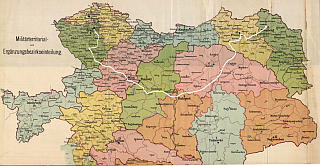
Švejk's journey is mapped on an Austria-Hungary map from 1914, showing the military districts of the
k.u.k. Heer. The entire plot of The Good Soldier Švejk is set within the territory of the former Dual Monarchy.
The Fateful Adventures of the Good Soldier Švejk (commonly known as The Good Soldier Švejk) by Jaroslav Hašek is rich in geographical
references, whether through the plot itself, in dialogues, or in the author's narrative voice. Hašek was unusually
well-travelled and had a photographic memory for geographical (and other) details. Geography mattered to him: eight
of the 27 chapter headings in the novel contain geographical names.
This website will, in due course, provide a complete overview of the novel's geographical references, from Prague in
the introduction to Klimontów in the unfinished Part Four. It includes continents, states (including defunct ones),
cities, market squares, city gates, regions, districts, towns, villages, mountains, mountain passes, oceans, lakes,
rivers, caves, channels, islands, streets, parks, and bridges.
The list is sorted according to the order in which the names appear in the novel. The chapter headings are taken from
Zenny Sadlon's recent translation (1999–2026); in most cases, these differ from Cecil Parrott's translation from 1973.
The Czech quotations are taken from the online version of The Good Soldier Švejk provided by Jaroslav Šerák and link to the relevant chapter. The
toolbar provides direct links to Wikipedia, Google Maps, Google Search, svejkmuseum.cz, and the novel online.
The names are colour-coded according to their role in the novel, as illustrated by the following examples:
Macedonia
is used as an adjective in the author's term for Alexander the Great, Alexandr Macedonský.
Background
Macedonia
was an ancient kingdom with its origin in the northern part of the Greek peninsula. During the reign of Philip II of Macedon and his son Alexander the Great, it became an enormous empire, stretching all the way to the river Indus. The capital at the time (400 BC to 300 BC) was Pella. Macedonia is the first of more than eight hundred geographical references in The Good Soldier Švejk, and it appears already in the third sentence! It is also the first of many references to ancient history, whether Roman or Greek.
Quote(s) from the novel
[Úvod] Velká doba žádá velké lidi. Jsou nepoznaní hrdinové, skromní, bez slávy a historie Napoleona. Rozbor jejich povahy zastínil by slávu Alexandra Macedonského. Dnes můžete potkat v pražských ulicích ošumělého muže, který sám ani neví, co vlastně znamená v historii nové velké doby.
Prague is mentioned 72 times in The Good Soldier Švejk.
Background
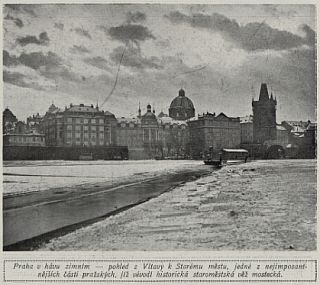
Prague
is the capital and largest city of Czechia. It is located on the river Vltava and the population is about 1.2 million. After 1648 Prague has been largely spared from warfare and, as a result, the old city centre is very well preserved. The city can thus offer intact architecture from several eras, and is considered one of the most beautiful in Europe. The inner city area has been on UNESCO's World Heritage List since 1992.
Prague was already an important city in the Middle Ages and reached its peak during the reign of Charles IV, who was also Holy Roman Emperor. After Bohemia came under the House of Habsburg rule from 1526 onwards, it gradually lost its importance and had, by the outbreak of World War I, been reduced to being one of several Austrian regional capitals.
Prague in 1914
At the outbreak of World War I, the city was much smaller than today, consisting of the districts I. Staré město, II. Nové město, III. Malá Strana, IV. Hradčany, V. Josefov, VI. Vyšehrad, VII. Holešovice-Bubny, and VIII. Libeň. The city was officially called Královské hlavní město Praha (the Royal Capital Prague).
The numbering of the districts differed from today's; Malá Strana, for instance, was Prague III, whereas it is now part of Praha I. The population count in 1910 was approximately 224,000; with suburbs included, it was 476,000. More than 90 per cent reported Czech as their everyday language. The rest were predominantly German speakers. In 1922, several adjoining districts were incorporated into the now Czechoslovak capital. The new administrative unit became known as Velká Praha.
Hašek's home city
Jaroslav Hašek was born at Školská 16 in Prague II on 30 April 1883. He lived in Prague and the nearby districts of Vinohrady and Smíchov until February 1915.
Between 19 December 1920 and 25 August 1921 he again resided in the city, now mostly in Žižkov, a neighbourhood that, in 1922, became part of the Czechoslovak capital. Part One and the beginning of Part Two of The Good Soldier Švejk were written in Žižkov, and perhaps other parts of the Prague conurbation, between March and August 1921.
Demography
According to the 1910 census, Prague had 223,471 inhabitants, of whom 212,067 (94 per cent) reported using Czech as their everyday language.
Per the recruitment districts, infantrymen from Prague were usually assigned to Infanterieregiment Nr. 28 (Prag) or k.k. Landwehrinfanterieregiment Nr. 8 (Prag). Prague was an important garrison city and was the seat of 8. Armeekorps, the unit Infanterieregiment Nr. 91 reported to. According to the census of 1910 the number of military personnel in the city was 5,168 of which 3,837 reported Czech as their native language. The house regiment was Infanterieregiment Nr. 28 but at the outbreak of war the garrison also hosted the staff of Infanterieregiment Nr. 11, Infanterieregiment Nr. 73, IR91 and Infanterieregiment Nr. 102. Additionally, it housed units from k.k. Landwehr, artillery, cavalry, supply troops and engineering troops.
Quote(s) from the novel
[Úvod] Dnes můžete potkat v pražských ulicích ošumělého muže, který sám ani neví, co vlastně znamená v historii nové velké doby.
[II.3] Desátník vzdychl: "Ani ty faldy na mantlu neuměl si udělat, až z Prahy si vobjednával vodičky a různý mastě na čistění knoflíků, a přece takovej jeho knoflík vypadal zrzavej jako Ezau.
[II.3] „Někdy,“ řekl Švejk, „se zas v gefechtu člověku udělá špatně, člověk si něco zvoškliví. Vypravoval v Praze na Pohořelci na ,Vyhlídce’ jeden nemocnej rekonvalescent od Přemyšlu, že tam někde pod festungem přišlo k útoku na bajonety a proti němu se vobjevil jeden Rus, chlap jako hora, a mazal si to na něho s bajonetem a měl pořádnou kapičku u nosu. Jak se mu von podíval na tu kapičku, na ten vozdr, že se mu hned udělalo špatně a musel jít na hilfsplac, kde ho uznali zamořenýho cholerou a odpravili do cholerovejch baráků do Pešti, kde se taky vopravdu nakazil cholerou.“
[II.5] "Z Prahy." "To bys měl bejt chytřejší... A ještě něco. Kdy šel váš rechnungsfeldvébl do kanceláře?"
[II.5] "Pro Ježíše Krista, a to říkáš, že jseš z Prahy. Ty se vo nic nestaráš. Kde lítáš celý dni?"
[II.5] "Jednou jsem jel z Vysočan elektrikou do Prahy a v Libni k nám přised nějakej pan Novotný.
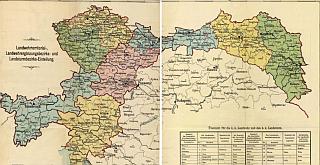
Map of Austria from 1913, here showing the recruitment districts of k.k. Landwehr.
Schematismus der k.k. Landwehr (s. 691),1913
Austria is mentioned 56 times in The Good Soldier Švejk.
Austria
is briefly mentioned in the introduction, but plays a key role throughout the novel and is mentioned many times. Austria-Hungary is however the principal target of Jaroslav Hašek's satire but he generally uses the term Austria even when referring to the entire Dual Monarchy.
The majority of the plot in The Good Soldier Švejk takes place on Austrian territory: Part One, about half of Part Two, the final chapter of Part Three, and all of Part Four. The remainder is set in the Hungarian part of the empire, namely the stay at Királyhida and part of the journey to the front until the Łupków Pass.
The satire is particularly biting in [I.15], where Švejk, for the first and only time, reveals his true opinion of Austria: "Such an idiotic monarchy ought not to exist on earth."
Background
Austria
in this context refers to the political entity that ruled the Czech lands from 1526 to 1918. From 1804 to 1867 the term applied to the entire the House of Habsburg Empire, but after the Ausgleich in 1867 it applied only to the Austrian part of what had by then become Austria-Hungary. Vienna was the capital throughout both periods.
A much-used unofficial term for Austria from 1867 to 1918 was Cisleithania (Ger. Cisleithanien, Cz. Cislajtanie), literally "the lands on this side of the Leitha". The official name until 1915 was Die im Reichsrat vertretenen Königreiche und Länder, and from 1915 again Österreich. The state was officially an empire and Emperor Franz Joseph I was emperor until his death in 1916. Politically, Austria was divided into 17 crown lands, which enjoyed varying degrees of political and cultural autonomy.
The result of the defeat in World War I was the empire's disintegration. The area was divided between the new states of Austria, Czechoslovakia, the Kingdom of Serbs, Croats and Slovenes (from 1929 Yugoslavia), Poland, and the already existing Italy and Romania.
Quote(s) from the novel
[Úvod] A tento tichý, skromný, ošumělý muž jest opravdu ten starý dobrý voják Švejk, hrdinný, statečný, který kdysi za Rakouska byl v ústech všech občanů Českého království a jehož sláva nezapadne ani v republice.>
[I.15] A oba pokračovali dále v rozhovoru, až konečně Švejk odsoudil Rakousko nadobro slovy: „Taková blbá monarchie nemá ani na světě bejt,“ k čemuž, aby jaksi ten výrok doplnil v praktickém směru, dodal druhý: „Jak přijdu na frontu, tak se jim zdejchnu.“
[II.4] Divizijní soud ve svém přípise na velitelství našeho pluku," pokračoval plukovník, "přichází k tomu mínění, že se vlastně o nic jiného nejedná než o soustavné štvaní proti vojenským částem přicházejícím z Cislajtánie do Translajtánie.
[III.1] Sláva Rakousku,` zvolal nadšené, ,sláva Rakousku! Nechť pokračuje se v té skvostné písni! Sláva našemu vojevůdci! Ať žije armáda!
Literature
Rakousko, Ottův slovník naučnýDíl 21. R (Ř) – Rozkoš,1904
Bohemia
is only briefly mentioned in the introduction (as the Czech Kingdom), but otherwise plays a minor role, at least in terms of direct references. Nevertheless, a substantial part of the plot and almost all the anecdotes take place within the territory of the former kingdom.
Bohemia
was a historical kingdom that existed from 1198, and from 1526 to 1918 it was a political entity (crown land) ruled by the House of Habsburg. Some of the Habsburg emperors were also crowned as kings of Bohemia. Emperor Franz Joseph I refused to be crowned, which caused considerable resentment among the Czechs.
The emperor's executive in the kingdom was the Statthalter (governor), who resided in Prague. The official languages were Czech and German. The kingdom was dissolved in 1918 and its territory became the most influential region in the newly proclaimed Czechoslovakia.
Quote(s) from the novel
[Úvod] A tento tichý, skromný, ošumělý muž jest opravdu ten starý dobrý voják Švejk, hrdinný, statečný, který kdysi za Rakouska byl v ústech všech občanů Českého království a jehož sláva nezapadne ani v republice.
[II.2] „Pak jste si ovšem spletl cestu,“ usměvavě řekl strážmistr, „poněvadž vy jdete od Českých Budějovic. O čemž vás mohu přesvědčit. Nad vámi visí mapa Čech. Tak se podívejte, vojáku. Od nás na jih je Protivín. Od Protivína na jih je Hluboká a od ní jižně jsou České Budějovice. Tak vidíte, že jdete ne do Budějovic, ale z Budějovic.“
[II.2] Zadíval se přitom do dobrácké tváře Švejkovy a zaklepal mu náhle v záchvatu dobromyslnosti na rameno, naklonil se k němu a optal se ho otcovským tónem: „Nu, a jak se vám v Čechách líbí?“
[II.2] „Mně se všude v Čechách líbí,“ odpověděl Švejk, „na svej cestě našel jsem všude velice dobrý lidi.“
[II.2] Tato nová situace umožnila ruským vyzvědačům, při pohyblivosti fronty, vniknutí hlouběji do území našeho mocnářství, zejména do Slezska i Moravy, odkud dle důvěrných zpráv velké množství ruských vyzvědačů odebralo se do Čech.
Czechoslovakia
is indirectly mentioned by the author through the terms "the republic" and "our republic". Later, there are several references, particularly in bitter outbursts against people who had worked for the Austrian oppressors and now live comfortably in the new republic. See Slavíček and Klíma.
In the epilogue to Part One, the country is mentioned by its full name.
Background
Czechoslovakia
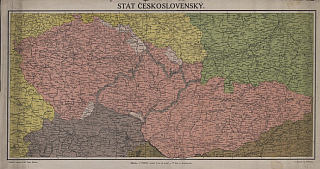
was a historic state in Central Europe. It was established on 28 October 1918 as a consequence of the collapse of Austria-Hungary at the end of World War I.
Czechoslovakia consisted of the regions of Bohemia, Moravia, Slovakia, Carpathian Ruthenia, and a small part of Silesia. In the inter-war years, the state enjoyed a functioning democracy with a strong industrial base. The infamous Munich Agreement of 1938 forced the country to cede to Germany the regions that were mainly populated by German speakers, and on 15 March 1939 the rest of the Czech lands were occupied by the Nazis and Slovakia became a German client state.
After the defeat of Germany, the country was restored with a democratic government, but in February 1948 the communists took power in a coup and a one-party state was established. In 1989, democracy was restored, but the state was peacefully split into the Czech Republic and Slovakia on 1 January 1993.
Quote(s) from the novel
[Úvod] A tento tichý, skromný, ošumělý muž jest opravdu ten starý dobrý voják Švejk, hrdinný, statečný, který kdysi za Rakouska byl v ústech všech občanů Českého království a jehož sláva nezapadne ani v republice.
[I.9] Může být, že dnes hejtman Linhart i za republiky je dále hejtmanem. Přál bych si, aby mu byla započtena služební léta na garnisoně. Slavíček a Klíma od státní policie je započteny mají. Řepa se vrátil do civilu a vykonává dál své zaměstnání zednického mistra. Může být, že je členem vlasteneckých spolků v republice. Štábní profous Slavík se stal zlodějem za republiky a je dnes zavřen. Nezakotvil chudák v republice jako jiní vojenští páni.
[I.14.2] Dnes jsou důstojničtí sluhové roztroušeni po celé naší republice a vypravují o svých hrdinných skutcích.
[I.16] Od hostinského Palivce nemůžeme žádat, aby mluvil tak jemně jako pí Laudová, dr Guth, pí Olga Fastrová a celá řada jiných, kteří by nejraději udělali z celé Československé republiky velký salon s parketami, kde by se chodilo ve fracích, v rukavičkách a mluvilo vybraně a pěstoval se jemný mrav salonů, pod jehož rouškou bývají právě salonní lvi oddáni nejhorším neřestem a výstřednostem.
Výbor ze spisů Xenofontových, Vilém Steinmann,1880
Ephesus
is mentioned in connection with Herostratus, the vain fool who here is contrasted with Švejk and described as his complete opposite. The term "herostratic fame" refers to Herostratos setting fire to the temple at Ephesus to gain fame.
Background
Ephesus
was in ancient times an important port on the western coast of Asia Minor with around 250,000 inhabitants. The city was the economic centre of Ionian Greece and later one of the most important cities of the Roman Empire. The city was home to one of the seven wonders of the world: the Temple of Artemis.
Quote(s) from the novel
[Úvod] On nezapálil chrám bohyně v Efesu, jako to udělal ten hlupák Herostrates, aby se dostal do novin a školních čítanek.




 czdeenno
SearchMap
czdeenno
SearchMap