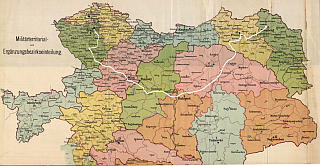
Švejk's journey is mapped on an Austria-Hungary map from 1914, showing the military districts of the
k.u.k. Heer. The entire plot of The Good Soldier Švejk is set within the territory of the former Dual Monarchy.
The Fateful Adventures of the Good Soldier Švejk (commonly known as The Good Soldier Švejk) by Jaroslav Hašek is rich in geographical
references, whether through the plot itself, in dialogues, or in the author's narrative voice. Hašek was unusually
well-travelled and had a photographic memory for geographical (and other) details. Geography mattered to him: eight
of the 27 chapter headings in the novel contain geographical names.
This website will, in due course, provide a complete overview of the novel's geographical references, from Prague in
the introduction to Klimontów in the unfinished Part Four. It includes continents, states (including defunct ones),
cities, market squares, city gates, regions, districts, towns, villages, mountains, mountain passes, oceans, lakes,
rivers, caves, channels, islands, streets, parks, and bridges.
The list is sorted according to the order in which the names appear in the novel. The chapter headings are taken from
Zenny Sadlon's recent translation (1999–2026); in most cases, these differ from Cecil Parrott's translation from 1973.
The Czech quotations are taken from the online version of The Good Soldier Švejk provided by Jaroslav Šerák and link to the relevant chapter. The
toolbar provides direct links to Wikipedia, Google Maps, Google Search, svejkmuseum.cz, and the novel online.
The names are colour-coded according to their role in the novel, as illustrated by the following examples:
Holice
was the home of a farmer who was the victim of a failed robbery and attempted murder. The attacker was one of the six who was locked up with Švejk at c.k. policejní ředitelství. He kept away from the other prisoners to avoid suspicion of having committed a political crime.
Background
Holice
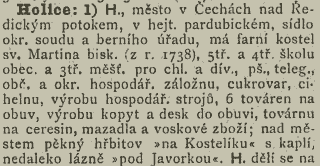
is a small town near Pardubice with a population of 6,542 (2022).
Demography
According to the 1910 census, Holice had 5,938 inhabitants, of whom 5,924 (99 per cent) reported using Czech as their everyday language. The judicial district was okresHolice, administratively it reported to hejtmanstvíPardubice.
Per the recruitment districts, infantrymen from Holice were usually assigned to Infanterieregiment Nr. 98 (Hohenmauth) or k.k. Landwehrinfanterieregiment Nr. 30 (Hohenmauth).
Quote(s) from the novel
[I.2] „Kvůli Sarajevu!“, „kvůli Ferdinandovi!“, „kvůli té vraždě na panu arcivévodovi!“, „pro Ferdinanda!“, „za to, že pana arcivévodu odpravili v Sarajevu!“. Šestý, který se těch pěti stranil, řekl, že s nimi nechce nic mít, aby na něho nepadlo nijaké podezření, on že tu sedí jen pro pokus loupežné vraždy na pantátovi z Holic.
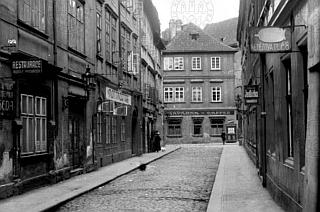
kol.1915 • Průhled Řetězovou ulicí. Uprostřed v pozadí dům čp. 232 v Husově ulici na Starém Městě.
Řetězová ulice
in the guise of Montmartre was where a stout owner of a stationery shop had been observed drunk by detective Brixi in the company of two Serbian students. This led directly to the cell at c.k. policejní ředitelství.
Background
Řetězová ulice
is a street in the centre of Prague, next to the present tourist route. Montmartre was at the time located here, and is now (2010) open again on the same premises.
Quote(s) from the novel
[I.2] Výjimku dělal neobyčejně tlustý pán s brýlemi, s uplakanýma očima, který byl zatčen doma ve svém bytě, poněvadž dva dny před atentátem v Sarajevu platil „U Brejšky“ za dva srbské studenty, techniky, útratu a detektivem Brixim byl spatřen v jejich společnosti opilý v „Montmartru“ v Řetězové ulici, kde, jak již v protokole potvrdil svým podpisem, též za ně platil.
Hodkovičky
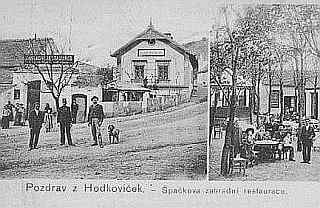
was where the chairman of the local charity Spolek Dobromil was unfortunate with his remarks when the police arrived to ask them to end the festivities, as Austria was in a state of mourning. The chairman ended up in the cell at c.k. policejní ředitelství with Švejk and the other conspirators.
Background
Hodkovičky
is a district on the southern outskirts of Prague by Vltava. In 1914, Hodkovičky was still a village and became part of the capital as late as 1949.
Demography
According to the 1910 census, Hodkovičky had 719 inhabitants, of whom 718 (99 per cent) reported using Czech as their everyday language. The judicial district was okresNusle, administratively it reported to hejtmanstvíKrálovské Vinohrady.
Per the recruitment districts, infantrymen from Hodkovičky were usually assigned to Infanterieregiment Nr. 28 (Prag) or k.k. Landwehrinfanterieregiment Nr. 8 (Prag).
Quote(s) from the novel
[I.2] Třetí spiklenec byl předseda dobročinného spolku „Dobromil“ v Hodkovičkách. V den, kdy byl spáchán atentát, pořádal „Dobromil“ zahradní slavnost spojenou s koncertem. Četnický strážmistr přišel, aby požádal účastníky, by se rozešli, že má Rakousko smutek, načež předseda „Dobromilu“ řekl dobrácky:
„Počkají chvilku, než dohrajou ,Hej, Slované’.“
In [II.4], the city is mentioned in an anecdote that Švejk tells his fellow inmates when he is locked up after the scandal with Gyula Kakonyi.
Background
London
was, in 1914, not only the capital of England but also the vast British Empire. The declarations of war against Germany on 4 August 1914 and the follow-up against Austria-Hungary on 12 August were issued from here.
The city was, from 1915 onwards, exposed to German air raids and 670 were killed. Other references connected to London in The Good Soldier Švejk are Sir Edward Grey and the magazine Country Life.
Quote(s) from the novel
[I.2] „Mne vůbec žádná vražda nezajímá, ať je třebas v Praze, ve Vídni, v Sarajevu nebo v Londýně. Od toho jsou úřady, soudy a policie. Jestli někde někoho zabijou, dobře mu tak, proč je trouba a tak neopatrný, že se dá zabít.“
[II.4] Začal dělat dědičně zatíženýho, a když ho štábní lékař prohlížel, tak prohlásil, že von nedesentýroval, že už vod mládí rád cestuje, že má vždycky touhu někam daleko zmizet. Že jednou se probudil v Hamburku a podruhý zas v Londýně, a že nevěděl, jak se tam dostal.
Záběhlice
is mentioned in an anecdote by Švejk where the question of guilt is on the agenda. Švejk "encouraged" his cell-mates with the fact that Jesus Christ was also innocent, but was sentenced nevertheless, just like the hapless gypsy in Záběhlice.
Záběhlice
is the name of several places in Bohemia, but the two near Prague are the likeliest candidates. The first and most likely candidate is a minor town that was situated in okresVršovice and has been a district of Prague since 1922. In the anecdote that Sappeur Vodička tells Švejk, this is definitely the place because he mentions Na Růžovém ostrově.
The other in the vicinity of Prague is located by Zbraslav and was somewhat smaller. Other locations with this name are found by Ledeč in Vysočina, by Příbram, and in Sedlčansko.
Demography
According to the 1910 census, Záběhlice had 2,669 inhabitants, of whom 2,664 (99 per cent) reported using Czech as their everyday language. The judicial district was okresVršovice, administratively it reported to hejtmanstvíKrálovské Vinohrady.
Per the recruitment districts, infantrymen from Záběhlice were usually assigned to Infanterieregiment Nr. 28 (Prag) or k.k. Landwehrinfanterieregiment Nr. 8 (Prag).
Quote(s) from the novel
[I.2] Nebo ten nevinnej cikán v Záběhlicích, co se vloupal do toho hokynářskýho krámu na Boží hod vánoční v noci. Zapřísáh se, že se šel vohřát, ale nic mu to nepomohlo.
[II.3] „Plácnu taky ženskou, Švejku, mně je to jedno, to ještě neznáš starýho Vodičku. Jednou v Záběhlicích na ,Růžovým ostrově’ nechtěla se mnou jít jedna taková maškara tančit, že prej mám voteklou hubu.
Kočevje
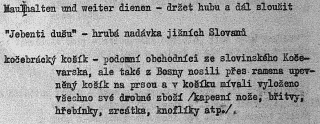
is indirectly mentioned through the term Kočevje-basket. This is when a Bosnian entered c.k. policejní ředitelství and was afraid to lose his basket.
Background
Kočevje
is a town and region in southern Slovenia that gave rise to the Czech expression Kočevje-basket. It was a basket that pedlars wore on their chest, supported by a belt around the shoulder.
The area around Kočevje was, for 600 years, a German-speaking enclave, known as Gottschee. The language Gottscheerisch is classified as Oberbairisch (Upper Bavarian) but over the centuries in isolation it grew more and more distinct from its origin.
After devastation by the Turks around 1500, the impoverished inhabitants were given imperial privileges to trade in the neighbouring areas, and they eventually expanded their trade as far as Vienna and Prague, carrying their characteristic baskets. The pedlars from Gottschee became a regular occurrence across large parts of the Habsburg Monarchy, particularly in winter. The trade started to suffer with the advance of the industrial revolution and better transport, but the final blow was the dissolution of Austria-Hungary, which left most of the Gottscheerers' markets beyond the new national borders.
It seems that the term Kočevje basket is particular to the Czech language and, to my knowledge, no similar term exists in German. In Grete Reiner's translation of the novel, a footnote is added to explain the meaning of Gottscheerkorb. The generic term in German is Hausiererkorb (pedlar's basket). None of the three English translations convey the geographical origin of the term, and Paul Selver's translation has no reference to the basket at all.
The dissolution of Austria-Hungary was only the first in a series of setbacks for the Gottschee community. They suffered severe discrimination in inter-war Yugoslavia, and in 1941 a disaster hit the region: the still numerous Gottschee inhabitants were forcibly moved because an agreement between Hitler and Mussolini decided that Kočevje was to become part of Italy. In post-war Yugoslavia, the language was even forbidden. Today the language is close to extinction; only scattered individuals in the USA, Austria, Slovenia and Germany master it. According to UNESCO, Gottscheerisch is amongst the world's critically endangered languages.
Gottscheerkorb
Hausiererkorb: Viele Einwohner der Gottschee, einer Sprachinsel in Slowenien, zogen besonders im Winter als Wanderverkäufer durch die Länder der alten Monarchie.
Demography
According to the 1910 census, Kočevje had 2,828 inhabitants. The judicial district was GerichtsbezirkGottschee, administratively it reported to BezirkshauptmannschaftGottschee.
Military
Per the recruitment districts, infantrymen from Kočevje were usually assigned to Infanterieregiment Nr. 17 (Laibach) or k.k. Landwehrinfanterieregiment Nr. 27 (Laibach).
Quote(s) from the novel
[I.2] Zatím přivedli nové dva. Jeden z nich byl Bosňák. Chodil po komoře, skřípal zuby a každé jeho druhé slovo bylo: „Jeben ti dušu.“ Mučilo ho pomyšlení, že se mu na policejním ředitelství ztratí jeho kočebrácký košík.
Eliščin most
is mentioned in an anecdote by Švejk about how well prison inmates are treated nowadays. The story refers to Jan Nepomucký, who is said to have been thrown off this bridge and drowned.
Eliščin mostElisabeth Bridge
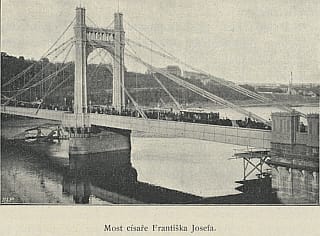
was the colloquial name for Most císaře Františka Josefa I. across Vltava in the northern part of Prague. It was demolished in 1947 and in its place the current Štefánikův most was built. Both the old and the new bridge have been renamed several times, the latest such occurrence was in 1997.
The body of the saint was, in fact, thrown off Karlův most.
Quote(s) from the novel
[I.2] Nebo mu dali nohy do španělský boty a natáhli ho na žebřík, když se nechtěl přiznat, nebo mu pálili boky hasičskou pochodní, jako to udělali svatému Janu Nepomuckému. Ten prej řval při tom, jako když ho na nože bere, a nepřestal, dokud ho neshodili s Eliščina mostu v nepromokavým pytli.
Golgotha
was an execution ground outside Jerusalem where Jesus was crucified between two rebels. The name is a Greek form of the Aramaic version Gûlgaltâ, which means "skull", and the name might refer to natural formations that resemble a skull or a place where many skulls are found. Golgotha is believed to have been near Jerusalem, but the location has not been confirmed.
Quote(s) from the novel
[I.2] A tak, stoupaje po schodišti do III. oddělení k výslechu, Švejk nesl svůj kříž na vrchol Golgoty, sám ničeho nepozoruje o svém mučednictví.




 czdeen
SearchMap
czdeen
SearchMap