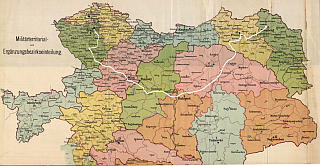
Švejk's journey is mapped on an Austria-Hungary map from 1914, showing the military districts of the
k.u.k. Heer. The entire plot of The Good Soldier Švejk is set within the territory of the former Dual Monarchy.
The Fateful Adventures of the Good Soldier Švejk (commonly known as The Good Soldier Švejk) by Jaroslav Hašek is rich in geographical
references, whether through the plot itself, in dialogues, or in the author's narrative voice. Hašek was unusually
well-travelled and had a photographic memory for geographical (and other) details. Geography mattered to him: eight
of the 27 chapter headings in the novel contain geographical names.
This website will, in due course, provide a complete overview of the novel's geographical references, from Prague in
the introduction to Klimontów in the unfinished Part Four. It includes continents, states (including defunct ones),
cities, market squares, city gates, regions, districts, towns, villages, mountains, mountain passes, oceans, lakes,
rivers, caves, channels, islands, streets, parks, and bridges.
The list is sorted according to the order in which the names appear in the novel. The chapter headings are taken from
Zenny Sadlon's recent translation (1999–2026); in most cases, these differ from Cecil Parrott's translation from 1973.
The Czech quotations are taken from the online version of The Good Soldier Švejk provided by Jaroslav Šerák and link to the relevant chapter. The
toolbar provides direct links to Wikipedia, Google Maps, Google Search, svejkmuseum.cz, and the novel online.
The names are colour-coded according to their role in the novel, as illustrated by the following examples:
England
was in 1914 at the centre of the British Empire, the largest colonial empire the world has ever seen. The empire entered the war on 4 August through its alliance with France and Russia (the Entente), provoked by the German invasion of Belgium. The declaration of war on Austria-Hungary followed on 12 August.
There was only limited fighting between British and Austro-Hungarian forces, as the former mostly operated on the Western Front, in the Middle East, in the colonies, and at sea. By the end of 1914, almost all the German colonies had been conquered. The British Empire's economic power and its control of the seas were crucial to the outcome of the war. The naval blockade of the Central Powers was particularly effective.
Quote(s) from the novel
[I.4] Člověk se tam může vydávat za pánaboha nebo za panenku Marii, nebo za papeže, nebo za anglickýho krále, nebo za císaře pána, nebo za sv. Václava, ačkoliv ten poslední byl pořád svázanej a nahej a ležel v isolaci.
[I.8] Baronka zatím vytahovala dárky z koše. Tucet pečených kuřat, zabalených do růžového hedvábného papíru a ovázaných černožlutou hedvábnou stužkou, dvě láhve nějakého válečného likéru s etiketou „Gott strafe England!“
[I.14.5] Francie, Anglie i Rusko jsou příliš slabé proti rakousko-turecko-německé žule.
[I.14.5] Pro chmel je nyní ztracena Francie, Anglie, Rusko i Balkán.
[II.3] Bylo jen slyšet, že zástupce vlády, když už byl po krk ve vodě, vykřikl: Gott strafe England!
[II.3] K nim přistupovaly dámy a rozdávaly jim perník s cukrovými nápisy „Sieg und Rache“, „Gott strafe England“, „Der Österreicher hat ein Vaterland. Er liebt’s und hat auch Ursach für’s Vaterland zu kämpfen.“
Krkonoše
is mentioned when it is revealed that a professor at blázinec claimed that the cradle of the gypsies was in these very mountains.
Background
KrkonošeGiant Mountains
is a mountain range on the border between Poland and the Czech Republic, in 1914 the border between Austria and Germany. The name is very old, mentioned by Ptolemy, and may be of Indo-European origin. The interpretation of the name has been preserved, and the Latin name was Gigantei montes. These are the highest mountains in Czechia, with Sněžka reaching 1,602 metres above sea level.
Quote(s) from the novel
[I.4] Taky jsem se tam sešel s několika profesory. Jeden s nich pořád chodil za mnou a vykládal, že kolíbka cikánů byla v Krkonoších, a ten druhý mně vysvětloval, že uvnitř zeměkoule je ještě jedna mnohem větší než ta vrchní.
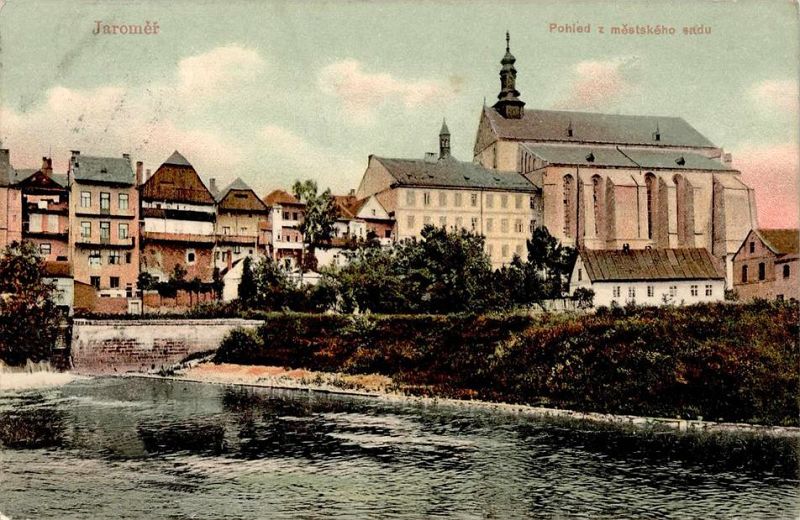
Jaroměř
is mentioned when Švejk, during his interrogation, lists the songs he knows. Immediately afterwards, he is thrown out of blázinec. This song, Když jsme táhli k Jaroměři, is mentioned twice more in the novel.
Background
Jaroměř
is an old town near Hradec Králové in eastern Bohemia. Today (2017) the town has around 12,000 inhabitants.
The song
The military song Švejk sings twice and mentions once during the plot is said to have been one of Hašek's favourites and is also mentioned in one of his short stories, Sportovní fejeton from 1911. According to Václav Pletka, it was originally called Když jsme táhli k Ostroměři, indicating that the origin was from the 1866 war with Prussia. The song has, over the years, appeared in many guises, some of them rather vulgar.
Demography
According to the 1910 census, Jaroměř had 8,213 inhabitants, of whom 8,026 (97 per cent) reported using Czech as their everyday language. The judicial district was okresJaroměř, administratively it reported to hejtmanstvíDvůr Králové nad Labem. Jaroměř was home to a parish and a post office.
Per the recruitment districts, infantrymen from Jaroměř were usually assigned to Infanterieregiment Nr. 18 (Königgrätz) or k.k. Landwehrinfanterieregiment Nr. 11 (Jičin). In 1914, one of the three battalions of k.k. Landwehrinfanterieregiment Nr. 11 was garrisoned in Jaroměř. Of the inhabitants in the town, 181 were listed as military personnel, a number explained by the proximity to the garrison town Josefov.
Quote(s) from the novel
[I.4] „Znám ještě první sloku z ,Kde domov můj’ a potom ,Jenerál Windischgrätz a vojenští páni od východu slunce vojnu započali’ a ještě pár takových národních písniček jako ,Zachovej nám, Hospodine’ a ,Když jsme táhli k Jaroměři’ a ,Tisíckrát pozdravujeme Tebe’...“
[II.1] Když jsme táhli k Jaroměři, ať si nám to kdo chce věří...
[III.4] Když jsme táhli k Jaroměři, ať si nám to kdo chce věří, přišli jsme tam asi právě k večeři...
Salmovská towards Ječná, marking the site of the former police station.
Pokrok západu,2.4.1902
Národní listy,6.6.1891
Salmova ulice
is first mentioned at the end of [I.4] when Švejk was sent to the police station in this street after being thrown out of the madhouse. Here he encounters the brutal inspector Inspektor Braun and shares a cell with a respectable citizen who has ended up on a slippery slope after a company party. The date of his stay must be just after 28 June 1914 because Švejk reads the declaration of war as he is escorted onwards to c.k. policejní ředitelství. Nearly all of [I.5] takes place at this police station.
Background
Salmova ulice
is the author's way of writing Salmovská ulice, a short and curved street in Prague II, not far from U kalicha. At the time, there was a police station at the corner of Ječná ulice (see policejní komisařství Salmova ulice). The street is named after Franz Altgraf von Salm-Reifferscheid, who at the end of the 18th century laid out a large garden behind house No. 506.
Naming conflicts
Why the author used the name Salmova ulice is not clear. The name of the street was changed from Salmova to Salmovská already in 1870, but newspaper adverts show that Salmova was in use well into the interwar years. Thus, the name was used side-by-side with the official Salmovská, so the use of Salmova is surely the author's choice (and not a typing mistake).
The wood trader Švejk
Interestingly, an advert from 1891 was placed by a certain Josef Švejk who lived at No. 14. He put beech planks up for sale.
Quote(s) from the novel
[I.4] Švejk prohlásil, že když někoho vyhazují s blázince, že ho nesmějí vyhodit bez oběda. Výtržnosti učinil konec vrátným přivolaný policejní strážník, který Švejka předvedl na policejní komisařství do Salmovy ulice.




 czdeennnno
SearchMap
czdeennnno
SearchMap