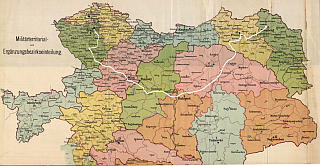
Švejk's journey is mapped on an Austria-Hungary map from 1914, showing the military districts of the
k.u.k. Heer. The entire plot of The Good Soldier Švejk is set within the territory of the former Dual Monarchy.
The Fateful Adventures of the Good Soldier Švejk (commonly known as The Good Soldier Švejk) by Jaroslav Hašek is rich in geographical
references, whether through the plot itself, in dialogues, or in the author's narrative voice. Hašek was unusually
well-travelled and had a photographic memory for geographical (and other) details. Geography mattered to him: eight
of the 27 chapter headings in the novel contain geographical names.
This website will, in due course, provide a complete overview of the novel's geographical references, from Prague in
the introduction to Klimontów in the unfinished Part Four. It includes continents, states (including defunct ones),
cities, market squares, city gates, regions, districts, towns, villages, mountains, mountain passes, oceans, lakes,
rivers, caves, channels, islands, streets, parks, and bridges.
The list is sorted according to the order in which the names appear in the novel. The chapter headings are taken from
Zenny Sadlon's recent translation (1999–2026); in most cases, these differ from Cecil Parrott's translation from 1973.
The Czech quotations are taken from the online version of The Good Soldier Švejk provided by Jaroslav Šerák and link to the relevant chapter. The
toolbar provides direct links to Wikipedia, Google Maps, Google Search, svejkmuseum.cz, and the novel online.
The names are colour-coded according to their role in the novel, as illustrated by the following examples:
Piešťany
is mentioned by doctor Doctor Grünstein when he informs Švejk that curing his rheumatism at the military hospital here (in Prague) would be much quicker than at Piešťany.
Background
Piešťany
is a spa in western Slovakia known for its treatment of rheumatism. Until 1920 it was part of Hungary, like the rest of Slovakia.
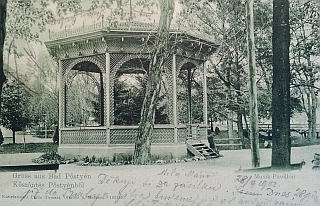
Jaroslav Hašek knew the place; on 28 September 1902 he sent a postcard from here to his cousin Marie. He visited together with Viktor Janota, Ján Čulen and Štefan Čulen.
Military
Per the recruitment districts, infantrymen from Piešťany were usually assigned to Infanterieregiment Nr. 72 (Pozsony) or Honvédinfanterieregiment Nr. 13 (Pozsony).
Quote(s) from the novel
[I.8] „A celé noci nemůže spát, není-liž pravda? Rheuma je velice nebezpečná, bolestná a těžká nemoc. My už tady máme s rheumatiky dobré zkušenosti. Naprostá dieta a jiný náš způsob léčení se velice dobře osvědčil. Budete zde dřív zdravější než v Píšťanech a mašírovat budete na posice, jen se za vámi zapráší.“
Credit: Radko Pytlík, Václav Menger, Jaroslav Šerák, LA PNP
Hradčany is mentioned 8 times in The Good Soldier Švejk.
Hradčany
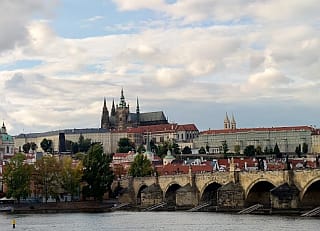
is where the plot in this and the next chapter takes place. Švejk is first placed in the sick-bay of Posádková věznice to be cured of his rheumatism, thereafter locked up in the actual prison, suspected of malingering. Švejk also appears in other places at Hradčany: Vojenský soud Hradčany, Vězeňské kaple and probably Vojenská nemocnice Hradčany.
Background
Hradčany
is a cadastral district in Prague which includes the castle area. This is where the offices of the president, St. Vitus Cathedral and many other landmarks are located. Hradčany is situated on a hill west of the Vltava and borders Dejvice, Strahov and Malá Strana. In 1914 the district was equivalent to Praha IV..
The Good Soldier Švejk in Captivity
In Dobrý voják Švejk v zajetí the military court is also part of the plot and to a greater degree than in the novel. Here too an auditor handles Švejk's case but he is not named. The narrator also explains how the Austro-Hungarian military judiciary works in general.[1]
V duchu opustil hradčanský vojenský soud a mysl jeho zaletěla na Vinohrady do malého krámku, svezla se po obraze Františka Josefa a vyhledala pod starou postelí dvě morčata. Švejk k smrti rád pěstoval morčata. A jich osud byl také jedinou chmurou zde.
Demography
According to the 1910 census, Hradčany had 5,412 inhabitants, of whom 4,911 (90 per cent) reported using Czech as their everyday language.
Per the recruitment districts, infantrymen from Hradčany were usually assigned to Infanterieregiment Nr. 28 (Prag) or k.k. Landwehrinfanterieregiment Nr. 8 (Prag).
Quote(s) from the novel
[I.8] Konečně poptávkou na policejním ředitelství zjištěno bylo, že to byl Švejk, a dále bylo už lehké pátrat. Baronka von Botzenheim vzala s sebou společnici a komorníka s košem a jeli na Hradčany.
Siam
is the former name of Thailand and roughly the area that corresponds to the modern state. Siam was never colonised but lost some territory to European imperial powers in the 19th century. The capital was always Bangkok.
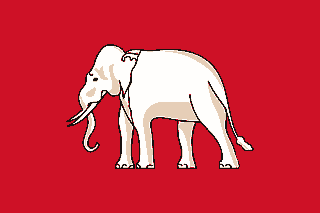
The term Siam elephant mostly refers to white (albino) animals that were regarded as sacred. It was even on the flag of Siam until 1916. Thus, Siam elephant is not a breed.
Quote(s) from the novel
[I.8] „Poslušně hlásím, že já vůbec nemyslím.“
„Himmeldonnerwetter,“ hulákal jeden z členů komise, břinkaje šavlí, „tak von vůbec nemyslí. Pročpak, vy jeden siamskej slone, nemyslíte?“




 czdeenhusk
SearchMap
czdeenhusk
SearchMap