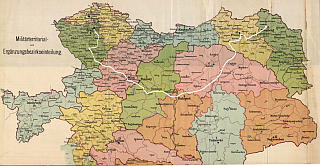
Švejk's journey is mapped on an Austria-Hungary map from 1914, showing the military districts of the
k.u.k. Heer. The entire plot of The Good Soldier Švejk is set within the territory of the former Dual Monarchy.
The Fateful Adventures of the Good Soldier Švejk (commonly known as The Good Soldier Švejk) by Jaroslav Hašek is rich in geographical
references, whether through the plot itself, in dialogues, or in the author's narrative voice. Hašek was unusually
well-travelled and had a photographic memory for geographical (and other) details. Geography mattered to him: eight
of the 27 chapter headings in the novel contain geographical names.
This website will, in due course, provide a complete overview of the novel's geographical references, from Prague in
the introduction to Klimontów in the unfinished Part Four. It includes continents, states (including defunct ones),
cities, market squares, city gates, regions, districts, towns, villages, mountains, mountain passes, oceans, lakes,
rivers, caves, channels, islands, streets, parks, and bridges.
The list is sorted according to the order in which the names appear in the novel. The chapter headings are taken from
Zenny Sadlon's recent translation (1999–2026); in most cases, these differ from Cecil Parrott's translation from 1973.
The Czech quotations are taken from the online version of The Good Soldier Švejk provided by Jaroslav Šerák and link to the relevant chapter. The
toolbar provides direct links to Wikipedia, Google Maps, Google Search, svejkmuseum.cz, and the novel online.
The names are colour-coded according to their role in the novel, as illustrated by the following examples:
Motol
is mentioned by the narrator as he explains that the Motol military training ground is used for executions of people who are sentenced by Vojenský soud Hradčany.
We must also assume that the plot took place here in [I.11] and [I.12]: the field masses described very probably took place here, and the fact that Feldkurat Katz and Švejk went to nearby Břevnovský klášter to pick up the monstrance and ciborium underpins this theory.
In [II.3] the place is mentioned again, now simply referred to as Motol. In this case the theme is the execution of reservist Kudrna. This incident is mentioned in the novel during the train journey from Budějovice to Királyhida.
Background
Motol
is a district in western Prague that became part of the capital in 1922. In 1910 it was a small village of 21 houses and 273 inhabitants. In the context of The Good Soldier Švejk, however, it refers to Motolské cvičiště (Motol exercise ground). During World War I it was the scene of several executions, where the best known victim was reservist Kudrna from Infanterieregiment Nr. 102 who was executed on 7 May 1915.
Fruit trees
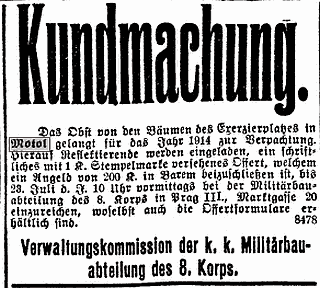
During the first field mass the author also mentions a plum-tree alley. Adverts in Prager Tagblatt reveal that Korpskommando tried to lease out fruit trees at the exercise ground[a]. It is not stated directly, but they may well have been plums.
Demography
According to the 1910 census, Motol had 273 inhabitants, of whom 273 (100 per cent) reported using Czech as their everyday language. The judicial district was okresSmíchov, administratively it reported to hejtmanstvíSmíchov.
Per the recruitment districts, infantrymen from Motol were usually assigned to Infanterieregiment Nr. 28 (Prag) or k.k. Landwehrinfanterieregiment Nr. 8 (Prag).
Quote(s) from the novel
[I.9] Z hradčanského garnisonu vedla také cesta přes Břevnov na motolské cvičiště. Napřed šel v průvodu bodáků člověk s řetízky na rukách a za ním vůz s rakví. A na motolském cvičišti úsečný povel: „An! Feuer!“ A po všech regimentech a batalionech četli plukovní rozkaz, že zas jednoho zastřelili pro vzpouru, když narukoval a pan hejtman sekl šavlí jeho ženu, která se nemohla od muže rozloučit.
[I.9] Nějaký pihovatý voják od zeměbrany, který měl největší fantasii, rozhlásil, že Švejk střelil po svém hejtmanovi a že dnes ho odvedli na motolské cvičiště na popravu.
[I.11] Vypadalo to jako indiánský tanec kolem obětního kamene, ale dělalo to dobrý dojem, zaplašujíc nudu zaprášeného, smutného cvičiště s alejí stromů švestkových vzadu a latrinami, jejichž vůně zastupovala mystickou vůni kadidla gotických chrámů.
[II.3] Teď prej toho hodně věšejí a střílejí,“ řekl jeden z mužů eskorty, „nedávno nám četli na execírplace befél, že v Motole vodstřelili záložníka Kudrnu, poněvadž hejtman sekl šavlí jeho chlapečka, kerej byl na ruce u jeho ženy, když se s ním v Benešově chtěla loučit, a von se rozčílil.
In the next chapter the narrator explains that the road from the Hradčany garrison to the Motol military training ground goes via Břevnov. It reappears in [I.11] when Feldkurat Katz and Švejk pass by the monastery to fetch the required items for the field mass.
Background
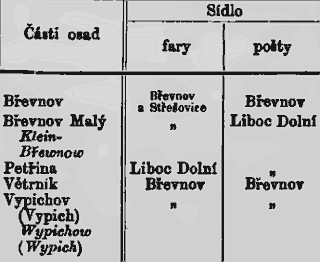
Břevnov
is a district in western Prague, between Střešovice and Motol. Administratively it is part of Prague 6. It is best known for its monastery. See Břevnovský klášter.
In 1907 Břevnov obtained city status and that year even His Imperial Majesty Emperor Franz Joseph I visited!
Demography
According to the 1910 census, Břevnov had 11,116 inhabitants, of whom 10,956 (98 per cent) reported using Czech as their everyday language. The judicial district was okresSmíchov, administratively it reported to hejtmanstvíSmíchov.
Per the recruitment districts, infantrymen from Břevnov were usually assigned to Infanterieregiment Nr. 28 (Prag) or k.k. Landwehrinfanterieregiment Nr. 8 (Prag).
Quote(s) from the novel
[I.8] „Já znám jednoho kominíka v Břevnově,“ poznamenal jiný pacient, „ten vám za deset korun udělá takovou horečku, že vyskočíte s okna.“
[I.9] Z hradčanského garnisonu vedla také cesta přes Břevnov na motolské cvičiště. Napřed šel v průvodu bodáků člověk s řetízky na rukách a za ním vůz s rakví.
North America
is mentioned because Feldkurat Katz's father emigrated there to avoid the consequences of his son's spectacular bankruptcy.
Background
North America
denotes a geographical area, the American continent north of the Panama Canal. There are many definitions, but the simplest one describes the area north of the Panama Canal and includes the Caribbean Islands. The largest states are the United States, Canada and Mexico. The first two both took part in World War I: the United States from 1917 and Canada already in 1914 as part of the British Empire.
Quote(s) from the novel
[I.9] Studoval obchodní akademii a sloužil jako jednoroční dobrovolník. A vyznal se tak dobře v směnečném právu a ve směnkách, že přivedl za ten rok obchodní firmu Katz a spol. k bankrotu tak slavnému a podařenému, že starý pan Katz odjel do Severní Ameriky, zkombinovav nějaké vyrovnání se svými věřiteli bez vědomí posledních i svého společníka, který odjel do Argentiny.
Argentina
is mentioned by the author when he relates the story of Feldkurat Katz's firm. His companion decided to emigrate to Argentina after their company's spectacular bankruptcy.
Background
Argentina
was until 1916 governed by a conservative elite, and was at the time a relatively wealthy republic. General male suffrage was introduced in 1912. The country was neutral in the world war and benefited greatly economically. A dispute with Germany occurred because some Argentine ships were sunk, but it never came to any formal declaration of war.
The country's capital is Buenos Aires and the official language is Spanish. The population is almost entirely of European descent, predominantly through immigration from Spain and Italy.
Quote(s) from the novel
[I.9] Studoval obchodní akademii a sloužil jako jednoroční dobrovolník. A vyznal se tak dobře v směnečném právu a ve směnkách, že přivedl za ten rok obchodní firmu Katz a spol. k bankrotu tak slavnému a podařenému, že starý pan Katz odjel do Severní Ameriky, zkombinovav nějaké vyrovnání se svými věřiteli bez vědomí posledních i svého společníka, který odjel do Argentiny.
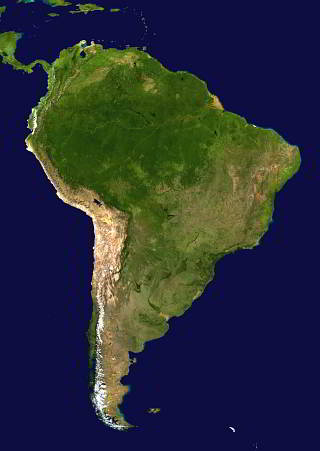
South America
is mentioned as the author relates the story of how the company Feldkurat Katz & Co had now moved to America, both North and South.
Background
South America
is the southernmost of the two continents that make up America. In 1914, it consisted of the same countries as today; it was only in Guyana that three colonies remained (one French, one Dutch and one British). All countries except Brazil (and the three mentioned colonies) had Spanish as their official language.
During World War I, all the states except Brazil maintained their neutrality. They entered the war on the side of the Entente in 1917 and sent auxiliary personnel to the Western Front, and the navy took over patrolling duties in the South Atlantic.
Fighting around the continent only took place at sea and was limited to 1914, when British and German naval forces clashed. The German Pacific Fleet was destroyed by the Falkland Islands on 8 December 1914 on their way home.
Quote(s) from the novel
[I.9] Když tedy mladý Otto Katz podělil firmou Katz a spol. nezištně Ameriku Severní i Jižní, octl se v situaci člověka, který nemá vůbec co dědit, neví, kam hlavu složit, a musí se dát na vojně aktivovat.
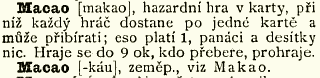
Macao
is a game of chance with cards named after the former Portuguese colony Macao in China. The game is believed to have originated in Hungary and appears to have been quite widespread in the Dual Monarchy.
Quote(s) from the novel
[I.9] „Chodíš ještě hrát karty?“ otázal se polní kurát. „S kartami jsem to všechno prohrál; posledně jsem hráli s tím plešatým plukovníkem makao a hodil jsem mu to všechno do chřtánu. Ale vím o jedné žábě. A co ty děláš, svatý otče?“
Slovakia
is mentioned in the narrative as a gypsy was accused by lawyer Auditor Bernis of having spoken in the pub about a future Czech-Slovak state under a common Slavic king. The gypsy was actually arrested for theft, but Bernis always mixed up the documents of the criminal proceedings.
Warning: Undefined array key "III" in /var/www/honsi.org/public_html/svejk/source/php/common/autolink.php on line 225
Later, some of the action in [. 4] takes place in eastern Slovakia, mainly in Humenné and Medzilaborce. Otherwise, many places in the country are mentioned through anecdotes and stories from the winter battle in the Carpathians in 1914-15.
Background
Slovakia
was in 1914 part of Austria-Hungary and was governed from Budapest. It was also referred to as Upper Hungary. From Ausgleich in 1867 onwards, Slovakia was subjected to increased magyarization, with oppression and discrimination, economically as well as culturally. Schools were closed and the Slovak language suppressed. During this period, international names like Bjørnson, Seton-Watson and Tolstoy came to the aid of the Slovak cause. The biggest city was Pozsony (ge. Pressburg), after the war renamed Bratislava.
From November 1914 to the spring of 1915, Russian forces occupied a smaller part of Slovak territory, but were finally pushed out in early May 1915. In 1918, Slovakia together with Bohemia, Moravia, Ruthenia and a small part of Silesia formed the new state of Czechoslovakia.
Hašek and Slovakia
Jaroslav Hašek knew Slovakia very well due to four extensive trips he made in the summers from 1900 to 1903. He wrote several stories that were inspired by these trips. In 1915 he again entered Slovakia, but now as a soldier. His march battalion actually stopped in Humenné on 2 July 1915. They travelled through the Laborec valley by train and this short stay is reproduced precisely in the novel (in a geographical sense at least).
Quote(s) from the novel
[I.9] Jeho prozíravost a znalost lidí byla tak veliká, že jednoho cikána, který se dostal od svého pluku na garnison pro krádež několika tuctů prádla (byl k ruce skladníkovi ve skladišti!), obvinil z politických zločinů, že prý někde v hospodě mluvil s vojáky o zřízení samostatného národního státu ze zemí koruny české a Slovenska se slovanským králem v čele.
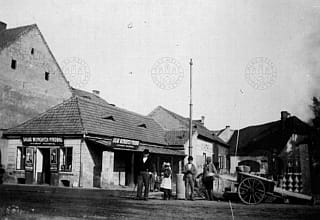
1896 • Pohled na domy čp. (zleva) 135 a 30 (Malý mlýn) v Mlýnské ulici v Libni.
Libeň
is mentioned by Švejk when he is interrogated by Auditor Bernis. In an anecdote he emphasises that he, just like the child who was found in Libeň, is an orphan and does not know why he is found and arrested. Libeň is mentioned in a few more anecdotes but the plot is never set there. See also U Exnerů, liquor trader Paroubek, Boušek and Na Zavadilce.
Background
Libeň
is an urban district and cadastral area in the north-eastern parts of Prague. It was granted town rights in 1898 but was included in Prague only three years later and administratively it became Praha 8.
Demography
According to the 1910 census, Libeň had 27,192 inhabitants, of whom 26,607 (97 per cent) reported using Czech as their everyday language.
Per the recruitment districts, infantrymen from Libeň were usually assigned to Infanterieregiment Nr. 28 (Prag) or k.k. Landwehrinfanterieregiment Nr. 8 (Prag).
Quote(s) from the novel
[I.9] „Poslušně hlásím, že to mohu vysvětlit náramně jednoduchým způsobem. U nás v ulici je uhlíř a ten měl úplně nevinnýho dvouletýho chlapečka a ten se jednou dostal pěšky z Vinohrad až do Libně, kde ho strážník našel sedět na chodníku.
[I.13] „Poslušně hlásím, pane feldkurát,“ poznamenal Švejk, „že je to hotovej nezmar, jako nějakej Boušek z Libně. Vosumnáctkrát za večer ho vyhodili od ,Exnerů’, a vždycky se jim tam vrátil, že tam zapomněl fajfku.
[II.3] Já jsem znal nějakýho kořalečníka Paroubka v Libni.
[II.3] Potom ještě řekl Paroubkovi, že je huncút a šaščínská bestie, tak ho milej Paroubek chyt, votlouk mu jeho pastě na myši a dráty vo hlavu a vyhodil ho ven a mlátil ho po ulici tyčí na stahování rolety až dolů na Invalidovnu a hnal ho, jak byl zdivočelej, přes Invalidovnu v Karlíně až nahoru na Žižkov, vodtud přes Židovský pece do Malešic, kde vo něj konečně tyč přerazil, takže se moh vrátit nazpátek do Libně.
[II.5] "Jednou jsem jel z Vysočan elektrikou do Prahy a v Libni k nám přised nějakej pan Novotný.




 cz
SearchMapŠvejkova cestaŠvejkův slovník
cz
SearchMapŠvejkova cestaŠvejkův slovník