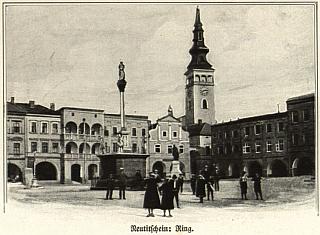
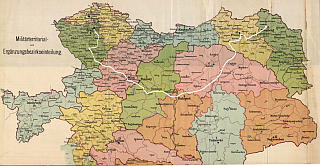
Švejk's journey is mapped on an Austria-Hungary map from 1914, showing the military districts of the
k.u.k. Heer. The entire plot of The Good Soldier Švejk is set within the territory of the former Dual Monarchy.
The Fateful Adventures of the Good Soldier Švejk (commonly known as The Good Soldier Švejk) by Jaroslav Hašek is rich in geographical
references, whether through the plot itself, in dialogues, or in the author's narrative voice. Hašek was unusually
well-travelled and had a photographic memory for geographical (and other) details. Geography mattered to him: eight
of the 27 chapter headings in the novel contain geographical names.
This website will, in due course, provide a complete overview of the novel's geographical references, from Prague in
the introduction to Klimontów in the unfinished Part Four. It includes continents, states (including defunct ones),
cities, market squares, city gates, regions, districts, towns, villages, mountains, mountain passes, oceans, lakes,
rivers, caves, channels, islands, streets, parks, and bridges.
The list is sorted according to the order in which the names appear in the novel. The chapter headings are taken from
Zenny Sadlon's recent translation (1999–2026); in most cases, these differ from Cecil Parrott's translation from 1973.
The Czech quotations are taken from the online version of The Good Soldier Švejk provided by Jaroslav Šerák and link to the relevant chapter. The
toolbar provides direct links to Wikipedia, Google Maps, Google Search, svejkmuseum.cz, and the novel online.
The names are colour-coded according to their role in the novel, as illustrated by the following examples:
Zlíchov
is brought into the story by Švejk when he tells Feldkurat Martinec that all the field chaplains he knows smoke like the distillery in Zlíchov.
Background
Zlíchov
is a small district of Prague, situated on the western bank of the Vltava south of Smíchov. Švejk refers to the distillery (lihovar) shown in the picture.
Quote(s) from the novel
[IV.2] „To se divím,“ řekl Švejk. „Znal jsem mnoho feldkurátů a ti kouřili jako špirituska na Zlíchově. Feldkuráta si vůbec nemůžu představit, aby nekouřil a nepil.
[IV.2] Von byl totiž ten pan Faustýn úplně vožralej a zapomněl, že já bydlím v Opatovickej ulici docela v nízkém přízemí, a ne ve třetím patře jako před rokem, když jsem bydlel v Křemencovej ulici a von ke mně chodil na návštěvu.“




 cz
SearchMap
cz
SearchMap.jpg)