The Good Soldier Švejk mentions numerous institutions and firms, both public and private. Until 15 September 2013, these were categorised as
'Places' on these pages. That categorisation only partly makes sense, because this type of entity cannot always be
tied to geographical coordinates in the way that cities, mountains, and rivers can. This page therefore covers
military and civilian institutions (including army units, regiments, etc.), organisations, hotels, public houses,
newspapers, and magazines.
The boundary between this page and 'Places' is not always clear-cut. Churches, for instance, rarely change location
yet are still included here. By contrast, Prague and Vienna remain in the 'Places' database because they have fixed
coordinates. Institutions, however, may move: Odvodní komise and Bendlovka are not unambiguous geographical terms,
so they are listed on this page.
The names are colour-coded according to their role in the novel, as illustrated by the following examples:
U kalicha, a location where the plot takes place.
k.u.k. Kriegsministerium, mentioned in the narrative.
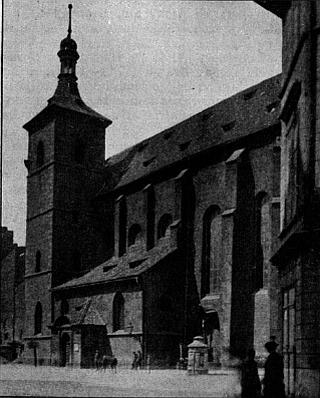
Kostel svatého Haštala
is mentioned by Švejk when he warns Oberleutnant Lukáš not to walk Fox near U mariánského obrazu, where they have a butcher's dog that is every bit as ill-tempered as the beggar from the Saint Castulus church.
Background
Kostel svatého HaštalaChurch of Saint Castulus
is a church in Prague, Staré město, built in Gothic style. It is named after Saint Castulus, one of the first Christian martyrs. The church is one of the oldest in Praha, the predecessor was erected in the 13th century. The current structure was consecrated in 1375 and was finished by 1399.
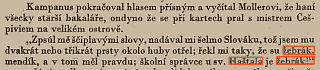
The beggar
Hašek may have picked the theme of the beggar and the church from the historical novel Mistr Kampanus by Zikmund Winter. It was published in 1906[a].
Quote(s) from the novel
[I.15] Jak uvidí ve svým rayoně cizího psa, hned je na něho žárlivej, aby mu tam něco nesežral. Von je jako ten žebrák od svatýho Haštala.“
U mariánského obrazu
is mentioned when Švejk informs Oberleutnant Lukáš that a mean dog, owned by a butcher, has his territory here and that he better not go there with Max.
Background
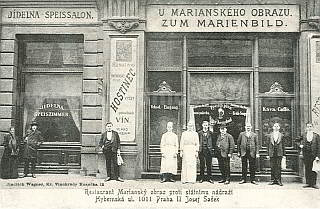
U mariánského obrazu
was a restaurant in Hybernská ulice. It was located on the ground floor in number 1011, right opposite the departure hall of Státní nádraží (Staatsbahnhof), present-day Masarykovo nádraží. It should not be confused with the current restaurant (2011) by the same name in Žižkov.
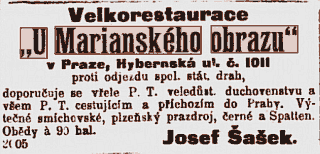
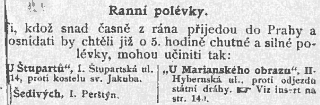
There were several pubs with this name in Prague at the time, but due to the fact that the wicked dog strayed to Havlíčkovo náměstí, we can safely assume that Švejk had the pub in Hybernská in mind. It was a large tavern, obviously popular with travellers. In the decade before World War I they served beer from Smíchov and Plzeň and offered soup from five o'clock in the morning!
Long history
The restaurant has a history at least back to 1877 in what was then house number 104. In 1878 some Leopold Ortl became landlord. Some time around 1890 the old house was demolished and number 1011 erected on the site. The restaurant continued operating in the new building. From 1897 and at least until 1914 Josef Šašek was landlord, running the place together with his wife Marie. The couple and their three children lived on the premises.
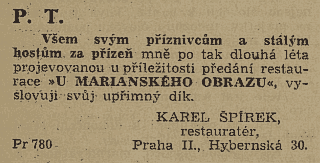
The address book from 1939 shows that the establishment was still operating, managed by Jan Cimický. He had presumably succeeded Karl Špirek who had managed the restaurant until the autumn of 1937. As late as 27 June 1948 an advert appeared in Rudé právo, but when the establishment closed down for good is not known.
Quote(s) from the novel
[I.15] A taky bych vám neradil vodit ho přes Havlíčkovo náměstí, tam se potlouká jeden zlej řeznickej pes vod ,Mariánskýho vobrazu’, kterej je náramně kousavej.
Číňan Staněk
was a "Chinese" who had a convex mirror. Švejk told Oberleutnant Lukáš this story when the latter was wondering if he liked his own looks. Švejk revealed that he did not like the sight of himself in Staněk's mirror.
Background
Číňan Staněk
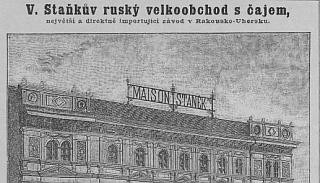
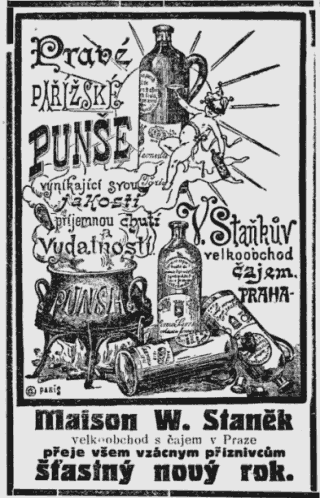
no doubt refers to the warehouse Maison Staněk. It was located at Ferdinandova třída 32, with stores and offices at the nearby Vladislavova ulice no. 13 (from 1896 no. 17). They imported and sold art and industrial goods from the Far East, tea, wine and rum. They also manufactured bamboo furniture. The firm was founded in 1876 by Vilém Staněk and adverts from after 1880 reveal that they focused on importing tea. The firm's name was Staňkův ruský obchod s čajem (Staněk's Russian tea trade).
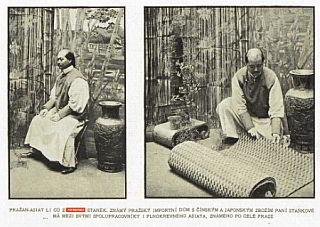
Thus it was not a question of a "Chinese" in the true meaning of the word although the Chinese Li Gü was employed there and was well known in the city. One of the shop windows displayed a convex mirror.
Vilém Staněk
The owner was born in 1853 and was only 23 when he established the enterprise. He had travelled a fair deal in British and French colonies, among them India, and had lived in Paris for a few years. The firm grew rapidly and full-page adverts in Prager Tagblatt a.o. reveal details from their history. They were represented in several cities around the world, among them Yokohama and Hong Kong. In 1909 they opened a new outlet in Pilsen.
Every year Staněk attended auctions in Nishny Novgorod and London. He wrote expert articles on tea and also published the magazine Staňkův Světem (Staněk across the world). It appeared from 1889 to 1896, with content in Czech and German, edited by Hanuš Wahner. Staněk was regarded a master at marketing, helped by his younger brother Emanuel who provided illustrations.
Staněk died on 22 November 1893 from lung tuberculosis, at a mere age of 40. His wife Kateřina (born 1866) took over the enterprise after her husband passed away. The company remained in business until 1938 when it went bankrupt.
Quote(s) from the novel
[I.15] „Poslušně hlásím, pane obrlajtnant, že se nelíbím, jsem v tom zrcadle nějakej takovej šišatej nebo co. Vono to není broušený zrcadlo. To jednou měli u toho Číňana Staňka vypouklý zrcadlo, a když se někdo na sebe podíval, tak se mu chtělo vrhnout. Huba takhle, hlava jako dřez na pomeje, břicho jako u napitýho kanovníka, zkrátka figura. Šel kolem pan místodržitel, podíval se na sebe a hned to zrcadlo museli sundat.“
OberkommandoHigh Command
probably refers to Armeeoberkommando (abbr. AOK), the highest military command during the war. From the outbreak of hostilities until the end of 1916, it was formally headed by Archduke Friedrich, but in practice the war effort was directed by the General Staff under Feldmarschall Conrad.
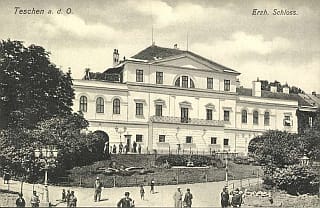
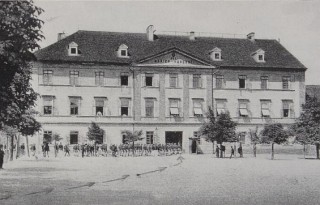
At the time of the events in The Good Soldier Švejk, AOK was based in Teschen (now Cieszyn)[a], in the palace owned by Friedrich himself[b].
In The Good Soldier Švejk, Oberkommando and Militärkommando probably both refer to AOK, although commands at subordinate levels cannot be ruled out.
Quote(s) from the novel
[I.15]Vrchní velitelství nedávno nám oznámilo, že jest u 91. pluku velký nedostatek důstojnictva, poněvadž to všechno Srbové pobili. Zaručuji se vám čestným slovem, že do tří dnů jste u 91. pluku v Budějovicích, kde se formují maršbatalióny.




 czen
SearchMapŠvejkova cestaŠvejkův slovník
czen
SearchMapŠvejkova cestaŠvejkův slovník