The Good Soldier Švejk mentions numerous institutions and firms, both public and private. Until 15 September 2013, these were categorised as
'Places' on these pages. That categorisation only partly makes sense, because this type of entity cannot always be
tied to geographical coordinates in the way that cities, mountains, and rivers can. This page therefore covers
military and civilian institutions (including army units, regiments, etc.), organisations, hotels, public houses,
newspapers, and magazines.
The boundary between this page and 'Places' is not always clear-cut. Churches, for instance, rarely change location
yet are still included here. By contrast, Prague and Vienna remain in the 'Places' database because they have fixed
coordinates. Institutions, however, may move: Odvodní komise and Bendlovka are not unambiguous geographical terms,
so they are listed on this page.
The names are colour-coded according to their role in the novel, as illustrated by the following examples:
U kalicha, a location where the plot takes place.
k.u.k. Kriegsministerium, mentioned in the narrative.
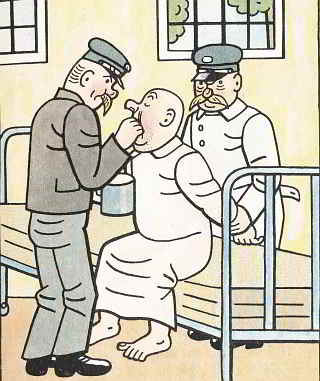
Blázinec
is referred to when Švejk is led to a psychiatric institution after a commission of psychiatrists conclude that he is a "malingerer with a feeble mind". He might have spent several weeks here as he was only released on 29 July 1914, the day Austria-Hungary declared war on Serbia.
Background
Blázinecthe madhouse
was some mental hospital in Prague which is not explicitly located. Still, we can with near certainty conclude that the author had Kateřinky in mind. This is an institution where he himself spent a few weeks in February 1911.
Quote(s) from the novel
[I.4] Když později Švejk líčil život v blázinci, činil tak způsobem neobyčejného chvalořečení: „Vopravdu nevím, proč se ti blázni zlobějí, když je tam drží. Člověk tam může lézt nahej po podlaze, vejt jako šakal, zuřit a kousat. Jestli by to člověk udělal někde na promenádě, tak by se lidi divili, ale tam to patří k něčemu prachvobyčejnýmu. Je tam taková svoboda, vo kterej se ani socialistům nikdy nezdálo.
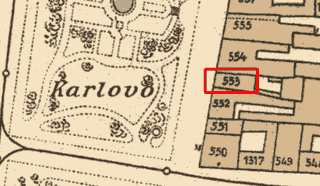
Orientační plán král. hl. města Prahy a obcí sousedních,1910-1914
Ottův slovník naučný
was mentioned in connection with the patient at blázinec who claimed to be the 16th volume of this encyclopaedia.
Background
Ottův slovník naučnýOtto's encyclopaedia
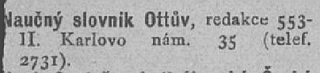
is an encyclopaedia by publisher Otto, regarded as an outstanding work of reference, also in an international context. A total of 28 volumes were published between 1888 and 1909, with additional supplements appearing thereafter. At the time, Otto's Encyclopaedia was one of the largest in the world. The editorial offices were located at Karlovo náměstí, in the building next to Otto's publishing house.
Emil Artur Longen (1928) claims that Jaroslav Hašek made active use of the encyclopaedia when writing The Good Soldier Švejk. This seems likely, as the lengthy tirade used by Rekrut Pech is almost a direct quotation from the encyclopaedia.
The reference to kartonážní šička (cardboard stapler) cannot be found in volume 16 (Lih-Media), and Antonín Měšťan also points out that there is no such entry in the encyclopaedia at all. Had it existed, it would have been found in volume 14. However, this volume only contains a reference to kartonáž, which simply points to the entry cartonage in volume five[c].
Durch einen Blick in den Ottův slovník naučný läßt sich leicht feststellen, daß das Stichwort "Kartonagenähgrin" nicht nur im 16. Band fehlt - es fehlt in diesem Lexikon überhaupt. Antonín Měšťan, 1983, Realien und Pseudorealien in Hašek's "Švejk"
Pech and Otto's encyclopaedia
Recruit Pech's monologue about Dolní Bousov closely resembles this entry in Otto's Encyclopaedia.
Ottův slovník naučný,1891
Rekrut Pech's monologue about his origins is almost a verbatim quotation from Ottův slovník naučný, as literary scholar Antonín Měšťan demonstrated in 1983[a].
Apart from a few minor discrepancies, The Good Soldier Švejk spells out the encyclopaedia's abbreviations while retaining its factual details[b].
Diese Information, für die der Offizier dem Rekruten Pech sechs Ohrfeigen verabreichte - eine für jeden Jahrmarkt - ist ein nur unwesentlich geändertes Zitat aus dem 4. Band des Ottův slovník naučný. Antonín Měšťan, 1983, Realien und Pseudorealien in Hašek's "Švejk"
Quote(s) from the novel
[I.4] Nejzuřivější byl jeden pán, kerej se vydával za 16. díl Ottova slovníku naučného a každého prosil, aby ho otevřel a našel heslo ,Kartonážní šička’, jinak že je ztracenej.
Orientační plán král. hl. města Prahy a obcí sousedních, 1910-1914
Břetislav Hůla
Baedeker
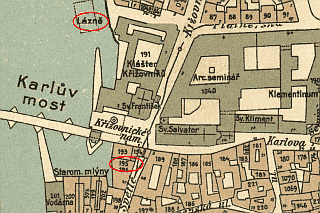
Královy lázně
is indirectly mentioned by Švejk when he at blázinec is asked if he likes having a bath. "It is better than at the baths by Charles Bridge", is the answer.
Background
Královy lázněRoyal Bath
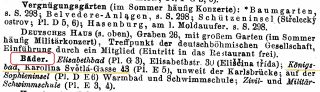
was a public bath at the end of Karlův most and is listed on the address Karoliny Světlé 43, indicated on the map. This is confirmed by Baedeker Österreich 1913 that refers to them as Königsbad.
Some baths north of the bridge are also shown, called Gemeindebad (Municipal Bath). This was more likely an open-air bath and to judge by the description in the novel, Švejk is almost certainly talking about the more luxurious indoor Royal Baths.
Břetislav Hůla refers to the bath as Karlovy lázně (Charles' Bath) and this corresponds to the entry in the address book of 1936. It is not known when exactly the renaming took place.
Quote(s) from the novel
[I.4] V koupelně ho potopili do vany s teplou vodou a pak ho vytáhli a postavili pod studenou sprchu. To s ním opakovali třikrát a pak se ho optali, jak se mu to líbí. Švejk řekl, že je to lepší než v těch lázních u Karlova mostu a že se velmi rád koupe.
Credit: Archiv Hlavního Města Prahy (Sbírka map a plánů)
Regimentskanzlei Budweis
is mentioned by Švejk when he tells the medical commission at blázinec that he has been released from the army due to feeblemindedness. He adds that this can be confirmed at the Ergänzungskommando in Karlín or the regimental office in Budějovice.
Background
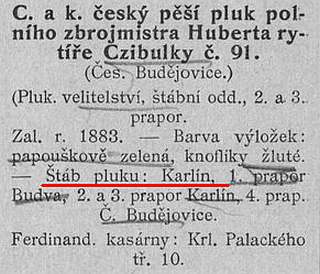
Regimentskanzlei BudweisRegimental office
was in 1914 stationed in Karlín and not in Budějovice as Švejk claims. When the war started, several regimental functions were indeed located in Ferdinandova kasárna in Karlín: 2. field battalion, regimental staff and IR. 91 regimental command itself. This inconsistency is probably due to a mix-up with the Ergänzungsbezirkskommando which together with the 4th battalion and Ersatzbataillon IR. 91 were indeed stationed in Budějovice.
We should also take into account that the barracks in Karlín were converted to a Red Cross reserve hospital soon after the outbreak of war and that the administrative functions of the regiment would now have been moved, some of them no doubt to Budějovice, and others to the front. See Ergänzungskommando.
The Good Soldier Švejk in Captivity
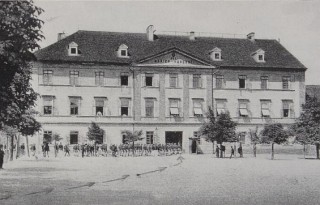
In Dobrý voják Švejk v zajetí the regiment's office and the barracks where it was located is the starting point of the plot. Švejk resisted attempts to dismiss him from the army; he wanted to serve his emperor. It is also stated that the barracks were built by Emperor Josef II..[1]
V canceláři regimentu pod číslem 16112 byl uschovnán akt týkající se průběhu i výsledku superarbitráčního řízení s dobrým vojákem Švejkem.
Quote(s) from the novel
[I.4] „Já, pánové,“ hájil se Švejk, „nejsem žádný simulant, já jsem opravdovej blbec, můžete se zpravit v kanceláři jednadevadesátýho pluku v Českých Budějovicích nebo na doplňovacím velitelství v Karlíně.“
Ergänzungskommando
is mentioned by Švejk when he tells the medical commission at blázinec that he has been released from the army due to feeble-mindedness. He adds that this can be confirmed at the reserve command in Karlín or Regimentskanzlei Budweis in Budějovice.
Background
ErgänzungskommandoReplenishment command
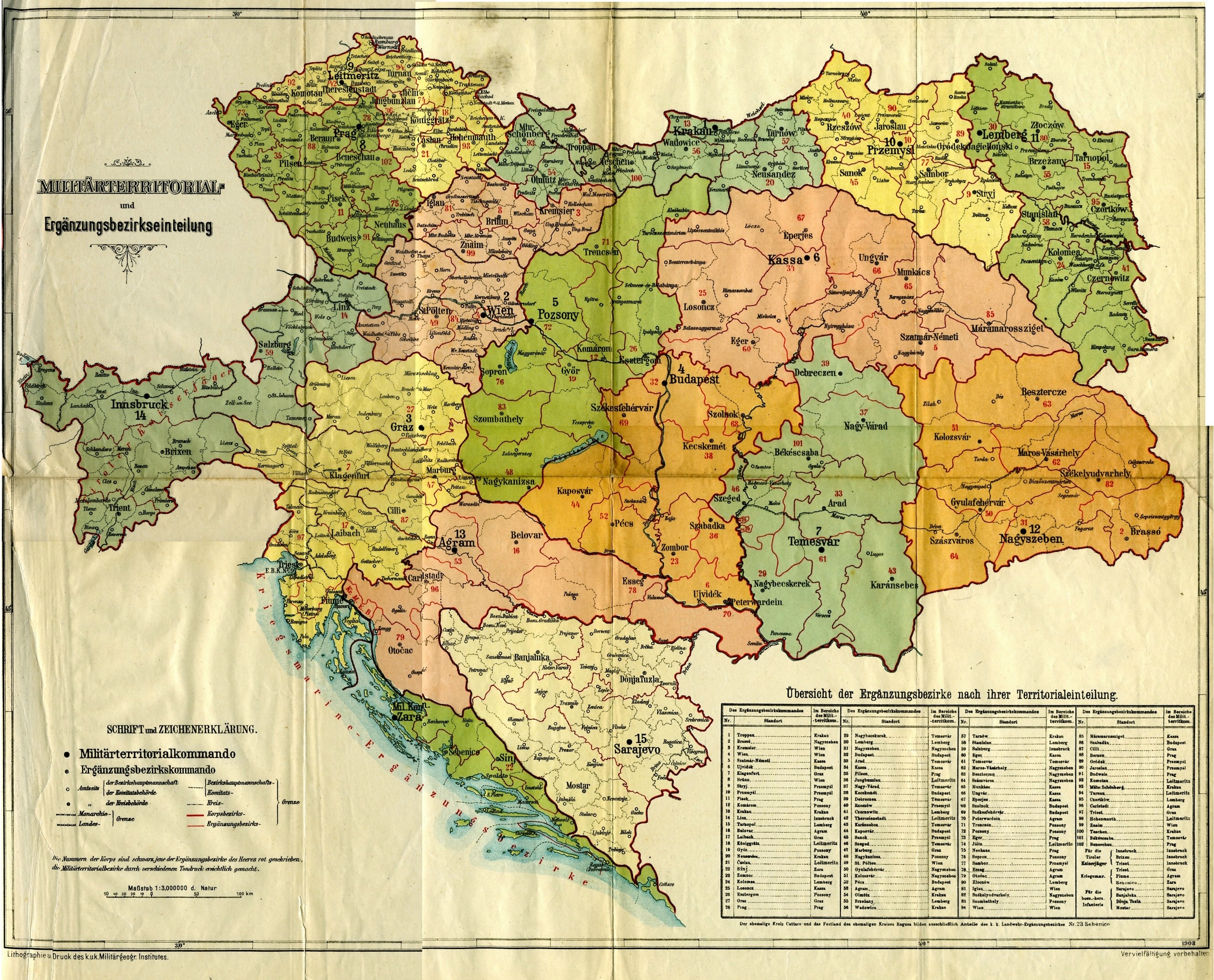
with near certainty refers to ErgänzungsbezirkskommandoBudweis. It was located in Backhaus in Budějovice (Pekárenská ulice) and not in Karlín as Švejk tells the doctors. At the outbreak of war, several other regimental functions resided in Ferdinandova kasárna in Karlín: III. Feldbataillon, regimental staff and the IR. 91 command. We may therefore be witnessing a straight mix-up between Regimentskanzlei Budweis and Ergänzungsbezirkskommando. Both are mentioned in the same sentence, so Švejk appears to have swapped the respective locations.
The district reserve commandBudweis (until 1912 Nr. 91 Budweis) was responsible for draft and call-up of reserves in Ergänzungsbezirk Budweis, see map. The recruitment district covered five hejtmanství: Budějovice, Týn nad Vltavou, Kaplice, Krumlov and Prachatice. The army units that the district provided recruits for were IR. 91 and 14. Dragonerregiment.
Commander in 1914 was colonel Johann Splichal but he was sent to the front soon after hostilities began, and it is not clear who replaced him. Splichal was also head of Ersatzbataillon IR. 91, and in this role, he was replaced by Karl Schlager. It may also be that the latter also succeeded him as head of the district reserve command. Usually, these two positions were held by the same officer. That would however not have been the case after 1 June 1915 when the replacement battalion was transferred to Királyhida, whereas the recruitment command for obvious reasons remained in its home district.
Quote(s) from the novel
[I.4] „Já, pánové,“ hájil se Švejk, „nejsem žádný simulant, já jsem opravdovej blbec, můžete se zpravit v kanceláři jednadevadesátýho pluku v Českých Budějovicích nebo na doplňovacím velitelství v Karlíně.“
[II.2] Že jsem mohl být felddienstunfähig. Taková ohromná protekce! Mohl jsem se válet někde v kanceláři na doplňovacím velitelství, ale má neopatrnost mně podrazila nohy.“
Policejní komisařství Salmova ulice
is the scene of a full chapter in the novel. Švejk is taken straight here after refusing to leave blázinec without lunch. His first encounter is with the brutal police inspector Inspektor Braun, but then the plot revolves mostly around a conversation with his fellow inmate, a very solid citizen who for the moment has slid off the path of virtue. Švejk does his utmost to convince him that his situation is beyond repair.
The stay here was only one afternoon, and Švejk was taken to the first floor for interrogation, this time by a fat and friendly police officer. Under escort he is led from the guard house (see Strážnice) on the ground floor onwards to c.k. policejní ředitelství. It was on the way that he read the emperor's declaration of war.
Background
Policejní komisařství Salmova uliceSalmova street police station
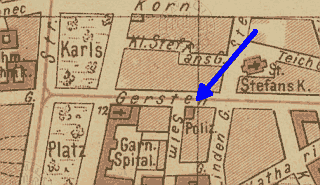
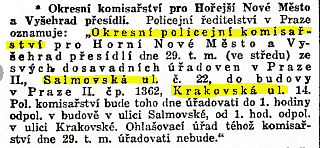
was the police station of the 3rd police district (HořejšíNové Město - Upper New Town) in Prague II. It was located on the corner of Ječná ulice and Salmovská ulice. The police station was operating until 29 June 1926, when it was moved to Krakovská ulice, where it is still located. The building was subsequently demolished, and in 1928 the current edifice was erected on the site.
The station was often called "Salmovka" in day-to-day speech, a term used by e.g. Zdeněk Matěj Kuděj in one of his books about Jaroslav Hašek (Ve dvou se to lépe táhne, 1924). The term is also listed in a German-language dictionary of Czech slang (Eugen Rippl, 1926).
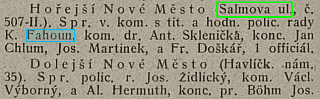
The chief inspector in 1906 and until 1910 was Karel Fahoun, and he was succeeded by Antonín Sklenička. No evidence has been found, in address books or elsewhere, that anyone named Inspektor Braun ever served here.
Hašek at Salmovská
This is a police station that Jaroslav Hašek knew well, because it was within this police district that he was born and grew up. Also, in his adult life, he for the most part lived within its jurisdiction. He was christened in Kostel sv. Štefána in the immediate vicinity, and on several occasions he lived only a few steps away. It has also been claimed that the author was a personal friend of police chief Karel Fahoun and his family but Břetislav Hůla refutes this claim after consulting Fahoun's son.
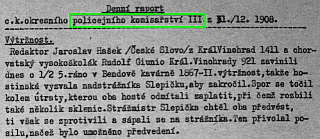
Police records from 1902 to 1912 reveal that Jaroslav Hašek was brought to the station several times. Most of the cases refer to breaches of public order and small-scale vandalism, induced by drinking. On New Year's Eve 1908 he and the Croat student Rudolf Giunio were arrested and locked up here after a pub brawl. Hašek was handed five days in prison for his "efforts". See Bendlovka for more information about this incident.
Quote(s) from the novel
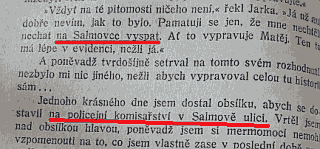
[I.5] Švejk prohlásil, že když někoho vyhazují s blázince, že ho nesmějí vyhodit bez oběda. Výtržnosti učinil konec vrátným přivolaný policejní strážník, který Švejka předvedl na policejní komisařství; do Salmovy ulice.
[I.5] „Víte co, Švejku,“ řekl vlídně pan komisař, „nač se zde, na Salmovce, máme s vámi zlobit? Nebude lepší, když vás pošleme na policejní ředitelství?“
Credit: Břetislav Hůla, Sergey Soloukh, Jaroslav Šerák