The Good Soldier Švejk mentions numerous institutions and firms, both public and private. Until 15 September 2013, these were categorised as
'Places' on these pages. That categorisation only partly makes sense, because this type of entity cannot always be
tied to geographical coordinates in the way that cities, mountains, and rivers can. This page therefore covers
military and civilian institutions (including army units, regiments, etc.), organisations, hotels, public houses,
newspapers, and magazines.
The boundary between this page and 'Places' is not always clear-cut. Churches, for instance, rarely change location
yet are still included here. By contrast, Prague and Vienna remain in the 'Places' database because they have fixed
coordinates. Institutions, however, may move: Odvodní komise and Bendlovka are not unambiguous geographical terms,
so they are listed on this page.
The names are colour-coded according to their role in the novel, as illustrated by the following examples:
U kalicha, a location where the plot takes place.
k.u.k. Kriegsministerium, mentioned in the narrative.
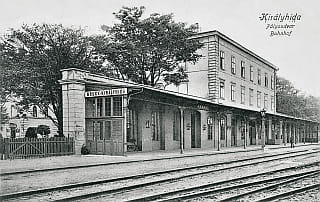
Bruck-Királyhida pályaudvar
is the setting for the departure of Švejk's march company for the front, probably on 22 May 1915. The station is not mentioned explicitly in the narrative, but the events must have taken place here.
Background
Bruck-Királyhida pályaudvarBruck-Királyhida Railway Station
was the railway station at Királyhida, opened in 1846. It is now officially known as Bruck/LeithaBahnhof. The old station building was demolished long ago.
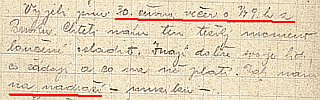
Jaroslav Hašek's XII. Marschbataillon departed from here on 30 June 1915 at 8.15 p.m. They arrived at the front near Gołogóry on 11 July.
Jan Vaněk, deník 2.7.1915
Když jsem v březnu putoval do špitálu, nepomyslel jsem si, že v červenci se budu zase těmi samými místy vracet do pole. Vyjeli jsme 30. června večer o 1/4 9 hod. z Brucku. Chtěli nám ten těžký moment loučení osladit. Znají dobře svoje lidi, co žádají a co na ně platí, Dali nám na nádraží—muziku—.
Quote(s) from the novel
[II.5] Při mně se ještě telefonovalo na nádraží. Nemají tam ani jeden volný vagón. To bylo zrovna tak s poslední marškou. Stáli jsme tenkrát dva dny na nádraží a čekali, až se nad námi někdo smiluje a pošle pro nás vlak.
[II.5] Tento optimistický názor nesdílela 13. marškumpačka, která telefonovala, že právě se vrátil kaprál Havlík z města a slyšel od jednoho železničního zřízence, že už vozy jsou na stanici.
[III.1] Konečně se všichni dočkali toho okamžiku, kdy je nacpali do vagonů v poměru 42 mužů k 8 koním. Koním ovšem se jelo pohodlněji než mužstvu, poněvadž mohli spát vstoje, ale to nevadilo. Vojenský vlak vezl do Haliče opět novou skupinu lidí hnaných na jatky. Celkem však se všem těm tvorům přece jen ulehčilo; bylo to něco již určitého, když se vlak hnul, ale předtím to byla jen trapná nejistota, panika, zdali se pojede již dnes, nebo zítra, či pozítří. Některým bylo jako odsouzeným k smrti, kteří očekávají se strachem, kdy si pro ně přijde kat. A potom nastane uklidnění, že už to bude odbyto.
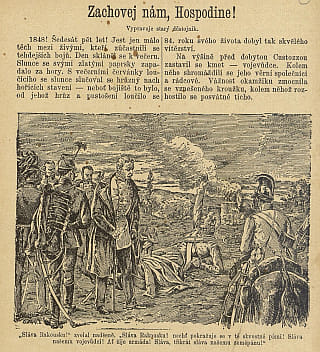
Kriegskalender
is mentioned by the author when he comments on Feldoberkurat Ibl's field mass before Švejk's march battalion departs from Bruck. Hašek notes that the material for the mass was clearly taken from war calendars.
Background
KriegskalenderWar calendar
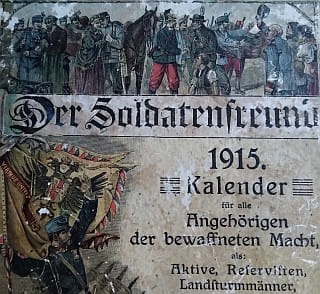
may at first seem a vague term, but closer examination reveals that Hašek drew on a specific calendar when composing Feldoberkurat Ibl's lofty speech for the departing march battalions in Királyhida. The source was a 1915 calendar published by J. Steinbrener, and the presence of a copy in Hašek's estate at LA-PNP reinforces this identification.
The crucial clue is a story entitled 'Gott Erhalte!' (God Preserve), attributed to 'an old officer'. In German, the calendar is titled Soldatenfreund, and the story appears on pages 72 and 73; most of Feldoberkurat Ibl's field mass derives from it.
The Czech version, Vojenský Přítel, has not been consulted, but Great Entertainment Calendar 1915 (the issue found in Hašek's estate) prints the same story on pages 61 and 62[a]. Strictly speaking, this was not a military calendar, but the volume is so heavily centred on military themes that Hašek may well have regarded it as one.
Steinbrener
All the calendars mentioned here were published by J. Steinbrener, a printing and publishing enterprise based in Winterberg (now Vimperk) in the Šumava region. It began as a publisher of prayer books, but later expanded into calendars and, eventually, books. Steinbrener had representatives in several cities across the Dual Monarchy and even in New York. In the years before World War I, the company employed 400 people, and in 1915 it printed 1.3 million calendars. Its range was impressive, with editions aimed at distinct groups of readers while still following a broadly consistent format. There were separate editions for the military, families, Catholics, and others, often with overlapping content. Steinbrener's flagship publication was the 'Great Entertainment Calendar', published in four volumes.
Hašek and war calendars
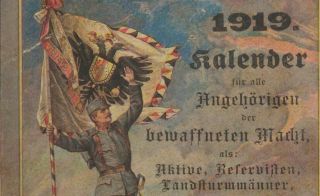
Z dob válečných,1919
Radko Pytlík notes in Kniha o Švejkovi (1982) p. 87 that Hašek had publisher Synek send old Austrian calendars to Lipnice, and Feldoberkurat Ibl's field mass suggests that he incorporated material from at least the 1915 issue into The Good Soldier Švejk.
Examination of the other wartime issues shows that the 1919 calendar (published in August 1918) was also used by Hašek. The propaganda posters that Švejk observed in Tábor in (C2,1) undoubtedly derive from this issue: all four motifs (six people) described in this sequence of The Good Soldier Švejk can be traced to it, and some of the passages are copied almost verbatim. In the case of Doctor Vojna, even a spelling mistake in the surname found its way into The Good Soldier Švejk.
Der Soldatenfreund,1919
The motifs are taken from pages 6 to 29, a section given over entirely to the monthly calendar proper. Each month is given two pages presenting a 'shining role model of courage and gallantry'. One page contains a drawing with a brief subtitle, while the facing or following page provides a fuller account of the heroic deed.
For Zugsführer Danko and Zugsführer Hammel (with Korporal Paulhart and Korporal Bachmayer), the short subtitles are reproduced unchanged. For Trainsoldat Bong, even the longer description is copied almost verbatim. In Doctor Vojna's case, however, only brief extracts from the description found their way into The Good Soldier Švejk, and the soldier's vivid imagination supplied the rest.
Quote(s) from the novel
[III.1] Měl přitom velice nadšenou řeč a bylo znát, že bral materiál z vojenských kalendářů.
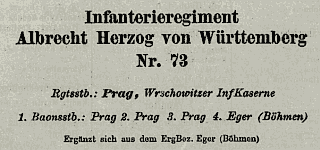
Infanterieregiment Nr. 73
is mentioned towards the end of telephone operator Chodounský's long tale about his adventures during the Austro-Hungarian military campaign in Serbia in 1914.
Background
Infanterieregiment Nr. 73
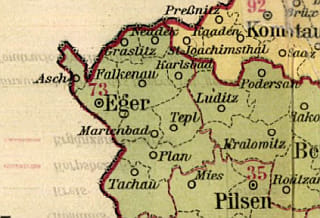
was one of 102 Austro-Hungarian infantry regiments. The Ergänzungsbezirk was Eger (now Cheb), and 97 per cent of the personnel reported German as their everyday language. Together with Infanterieregiment Nr. 11, they formed 18. Infanteriebrigade, who in turn was part of 9. Infanteriedivision.
Recruitment and garrison
Heeresergänzungsbezirk Nr. 73
Schematismus für das k.u.k. Heer (s. 1842),1912
In 1912, the Heeresergänzungsbezirk Nr. 73 included the following hejtmanství: Asch (Aš), Eger (Cheb), Falkenau (Sokolov), Graslitz (Kraslice), Karlssbad (Karlovy Vary), Marienbad (Mariánské Lázně), Neudek (Nejdek), Plan (Planá), Tachau (Tachov) and Tepl (Teplá).
It was common in Austria-Hungary for military units to be moved around the empire, and it was rare for an entire regiment to serve in the same garrison. The four battalions of an infantry regiment were usually stationed in 2-3 locations, and this was also the case with IR. 73. In 1914, the regimental staff and the 1st, 2nd and 3rd battalions were stationed in Vršovice kasárna, and the 4th battalion at Ergänzungsbezirkskommando in Eger (Cheb) [a].
The regimental commander in February 1914 was OberstAlbert Brunswik von Korompa[a] but sometime before the outbreak of war he was replaced by Oberst Karl Wilde[e], an officer who had been transferred from Infanterieregiment Nr. 88.
During the war
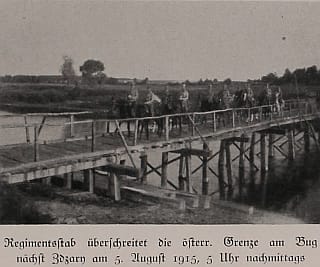
Crossing the river Bug
Geschichte des ehemaligen Egerländer Infanterie-Regiments Nr. 73,1939
The history of the regiment during World War I is very well documented as an entire book is dedicated to the regiment and the world war [d]. Here follows a brief summary, based on this book.
The regiment was mobilised at the outbreak of war and sent to the front at the Drina as part of 9. Infanteriedivision in 8. Armeekorps and subordinated to 5. Armee[c]. They took part in the three failed invasions of Serbia in the autumn of 1914 and were forced into a catastrophic retreat to Hungarian territory in mid-December.
Early in February 1915, they were transferred to the Carpathians, and after taking part in the winter battle there, they were involved in Central Powers's offensive in Galicia and Volhynia early in May.
In November 1915, together with the rest of 9. Infanteriedivision, they were transferred to the Isonzo front east of Monfalcone, on the so-called Karst plateau in modern Slovenia. They remained there until October 1917 (apart from an engagement south of Trento in the summer of 1916). The regiment took part in the advance into Italy after the breakthrough at Caporetto in October, and in November they reached Piave. In September 1918, they were sent back to Serbia, now in a futile attempt to strengthen the crumbling Macedonian front.
IR.73 and Hašek
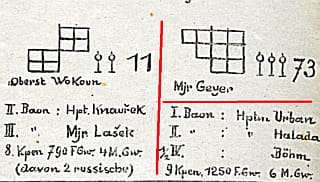
Ordre de Bataille, 3.7.1915
ÖStA/KA
During his entire service at the front (11.7 to 24 September 1916), Hašek fought side by side with IR.73 and IR.91 and was probably well informed about them. Both regiments suffered heavy losses during the Battle of Sokal at the end of August. The regimental commander at the time Hašek served at the front was OberstJohann Trampus.
Quote(s) from the novel
[III.1] Pak jsme byli jako sirotci, žádný o nás nic nechtěl vědět a přidali nás k 73. regimentu, abychom s ním odstupovali, což jsme s největší radostí udělali, ale napřed jsme museli mašírovat kupředu asi den, než jsme přišli k 73. regimentu.
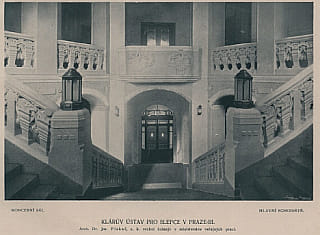
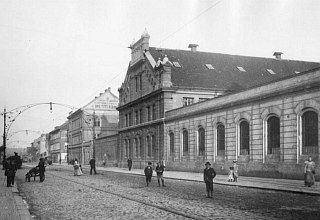
Klárův ústav slepců
was where the cook who replaced cook Jurajda in the officers' mess at Királyhida came from. The new chef was an unfortunate teacher at the Institute for the Blind at Klárov.
Background
Klárův ústav slepcůKlár's Institute for the Blind
was an institute for the blind from 1832 to 1945 and now (2010) houses the Česká geologická služba (Czech Geological Service). It was founded by and is named after Alois Klar (1763–1833).
Quote(s) from the novel
[III.1] Toto psaní bylo vynuceno okolnostmi, když kuchař okultista nadobro si rozlil ocet s plukovníkem Schröderem, který mu dosud držel palec, ale na kterého se při večeři na rozloučenou s důstojníky maršbatalionu opět, nešťastnou náhodou, nedostala porce rolované telecí ledviny, a plukovník Schröder ho poslal s marškumpačkou do pole, svěřiv důstojnickou kuchyni pluku nějakému nešťastnému učiteli z ústavu slepcůna Klárově.
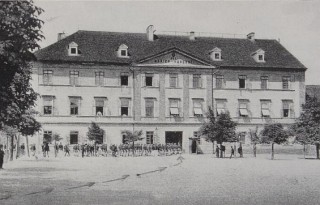
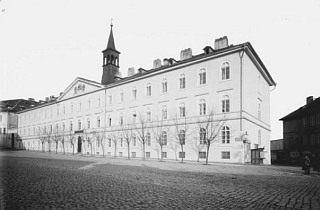
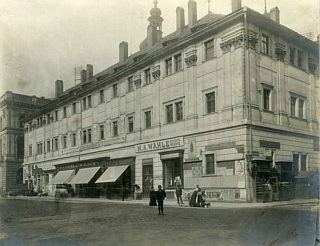
Celkový pohled na klášter sv. Havla (dům čp. 539) v Rytířské ulici na Starém Městě.
Průmyslová jednota
in Prague is mentioned by Švejk because he was once refused admission to the reading room there due to his shabby appearance.
Background
Průmyslová jednota
was an institution for the promotion of technical education. It was founded in 1833 and closed in 1950. The library and reading room in question were located in Rytířská ulice in Staré město.
Quote(s) from the novel
[III.1] „Vo tom stěhování duší jsem už taky slyšel,“ ozval se Švejk. „Já jsem si také jednou umínil před léty, že se, jak se s vodpuštěním říká, sám budu vzdělávat, abych nezůstal pozadu, a chodil jsem do čítárny Průmyslové jednoty v Praze, ale poněvadž jsem byl roztrhanej a svítily mně díry na zadnici, tak jsem se nemoh vzdělávat, poněvadž mne tam nepustili a vyvedli ven, poněvadž myslili, že jsem šel krást zimníky.
Daňkovka
refers to the industrial group Breitfeld-Daněk a spol., which merged with Českomoravská-Kolben, a.s. in 1927 to form ČKD, a company that remains in business. Its best-known product is probably the Tatra tram, which continues to operate in many former socialist countries. The company's first factory was in Karlín and is almost certainly the one mentioned by Švejk. See also negro Kristian.
Quote(s) from the novel
[III.1] Nadporučík Lukáš mluvil takovým hlasem, jako by se o něho pokoušela horečka, a toho okamžiku, když umlkl, využitkoval Švejk k nevinné otázce: „Poslušně hlásím, pane obrlajtnant, za prominutí, proč se nikdy nedozvím, co jsem vyved hroznýho: Já, pane obrlajtnant, jsem se vopovážil na to zeptat jenom kvůli tomu, abych se příště mohl takový věci vystříhat, když se všeobecně povídá, že se vod chyby člověk učí, jako ten slejvač Adamec z Daňkovky, když se vomylem napil solný kyseliny...“
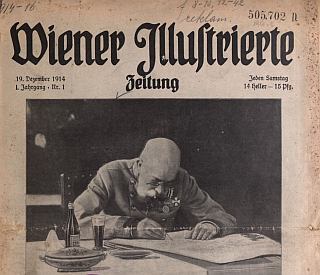
Wiener Illustrierte Zeitung
is mentioned when the author describes Kadett Biegler's dream on the train to Budapest. The landscape the cadet sees in the dream seems as though it were taken straight from this magazine.
Background
Wiener Illustrierte Zeitung
was an illustrated weekly published every Saturday. The first issue appeared on 19 December 1914, and the magazine continued until the end of 1916, with 107 issues published altogether. In the 1917 address book, the periodical was no longer listed. Its focus was on images from the war, celebrities, and patriotic propaganda. The photographs were of good quality for the period.
The paper was published by Gesellschaft für grafische Industrie, based in the district of Mariahilf (VI. Bezirk), near the centre of Vienna.
Vídeňské illustrované noviny
A Czech weekly with a similar title was also published in Vienna. However, it was an entirely different periodical and remained in circulation much longer, from 1906 to 1920.
Quote(s) from the novel
[III.1] Krajina měla týž ráz jako na obrázcích „Wiener Illustrierte Zeitung“. Po pravé straně bylo vidět u stodoly dělostřelectvo, jak střílí do nepřátelských zákopů vedle silnice, po které projížděl s automobilem.
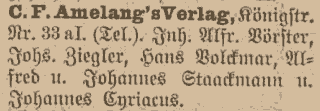
C.F. Amelang’s Verlag
is mentioned in a footnote by the author as the Leipzig publishing house that published professor Udo Kraft's book Self-Education for Death for the Emperor.
Background
C.F. Amelang’s Verlag
was a publishing house based in Leipzig. It specialised in school textbooks, pedagogy, and literary history. The firm was founded by Carl Friedrich Amelang (1785–1856) in 1806, but by 1915 ownership had passed out of the family.
Newspaper notices from the early years indicate that it was established in Berlin as a bookshop and traded from there until 1850, when it appears to have moved to Leipzig. In 1853, ownership seems to have passed to a certain Fr. Volckmar, and Hans Volckmar is listed as co-proprietor in 1915.
From 1917 to 1924, it gradually merged with other publishers to become Koehler &AmelangGmbH, a company that still exists.
Quote(s) from the novel
[III.1] Udo Kraft: Selbsterziehung zum Tod Für Kaiser. C.F. Amelang’s Verlag, Leipzig.