The Good Soldier Švejk mentions numerous institutions and firms, both public and private. Until 15 September 2013, these were categorised as
'Places' on these pages. That categorisation only partly makes sense, because this type of entity cannot always be
tied to geographical coordinates in the way that cities, mountains, and rivers can. This page therefore covers
military and civilian institutions (including army units, regiments, etc.), organisations, hotels, public houses,
newspapers, and magazines.
The boundary between this page and 'Places' is not always clear-cut. Churches, for instance, rarely change location
yet are still included here. By contrast, Prague and Vienna remain in the 'Places' database because they have fixed
coordinates. Institutions, however, may move: Odvodní komise and Bendlovka are not unambiguous geographical terms,
so they are listed on this page.
The names are colour-coded according to their role in the novel, as illustrated by the following examples:
U kalicha, a location where the plot takes place.
k.u.k. Kriegsministerium, mentioned in the narrative.
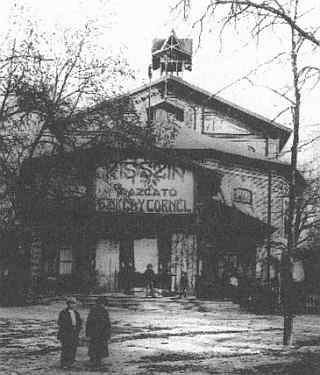
Kis SzínkörSmall Theatre
was a theatre and cabaret in Városliget (City Park) in Budapest. It was founded in 1904.
Quote(s) from the novel
[III.2] Zklamal se však úplně, neboť hejtman Ságner, kterému přinesl batalionsordonanc Matušič ze stanice večerní vydání „Pester Lloydu“, řekl, dívaje se do novin: „Tak vida, ta Weinerová, kterou jsme viděli v Brucku vystupovat pohostinsky, hrála zde včera na scéně Malého divadla.“
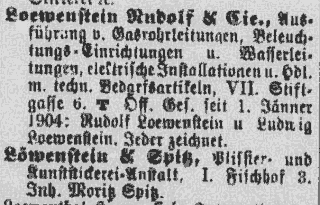
Firma Moritz Löwenstein
was a company from Vienna that supplied religious items. Here Offiziersdiener Baloun was eating little balls from a rosary manufactured by them, and the firm also supplied Klokoty. The author mentions Firma Moritz Mahler in [I.11] as a similar company.
Background
Firma Moritz Löwenstein
cannot be traced in the address book of Vienna 1915. Presumably, these names were chosen fairly randomly, apart from the common Jewish first name Moritz. See Firma Moritz Mahler.
Quote(s) from the novel
[III.2] A opravdu, Baloun ve svém největším hoři hledal spásu v drobných kuličkách z klokočí od firmy Moritz Löwenstein ve Vídni. „Ten je taky z Klokot,“ řekl smutně Baloun. „Než mně ho přinesly, zařvala dvě housata, ale to není žádný maso, to je měkkotina.“
U staré paní
was the pub where lathe operator Matějů had his jaw smashed by a brick. This is Švejk commenting that Mr. István was hit in the eye with a chicken.
Background
U staré paní
was a pub in Staré město, now a restaurant and hotel.
Quote(s) from the novel
[III.2] To vyrazili ,U starý paní’ soustružníkovi Matějů celou sanici cihlou za dvacet zlatejch, s šesti zubama, a tenkrát měly peníze větší cenu než dnes.
Filipa
is part of Švejk's interpretation of Leutnant Dub's quote from Shakespeare about Philippi. In a conversation with cook Jurajda, he concludes that Dub wanted to meet him "at a place near Filipa". The conclusion of Švejk is therefore that Dub is a "buserant" (homosexual).
Background
Filipa
was, by interpreting the text, a place where homosexuals met, surely somewhere in Prague.
Quote(s) from the novel
[III.2] „Pro nás, poslušně hlásím, pane lajtnant. Podívejte se, co má sádla.“ Poručík Dub odcházel bruče: „U Filippi se sejdeme.“ „Cože ti říkal?“ obrátil se k Švejkovi Jurajda. „Ale dali jsme si schůzku někde u Filipy. Voni tihle vznešení páni bejvají obyčejně buseranti.“